A USB pair at 107.8 Ω — high-speed checks that show their evidence
Running WireFrame's High-Speed Workbench on the open-source h730duino board — the USB 2.0 pair's impedance, skew and common mode, its EMI margin, and the fix — with the method and the source behind every number.
Update (2026-11): the High-Speed Workbench shipped in WireFrame 2.0.1 and comes with Pro and Max; the current release is 2.0.4.
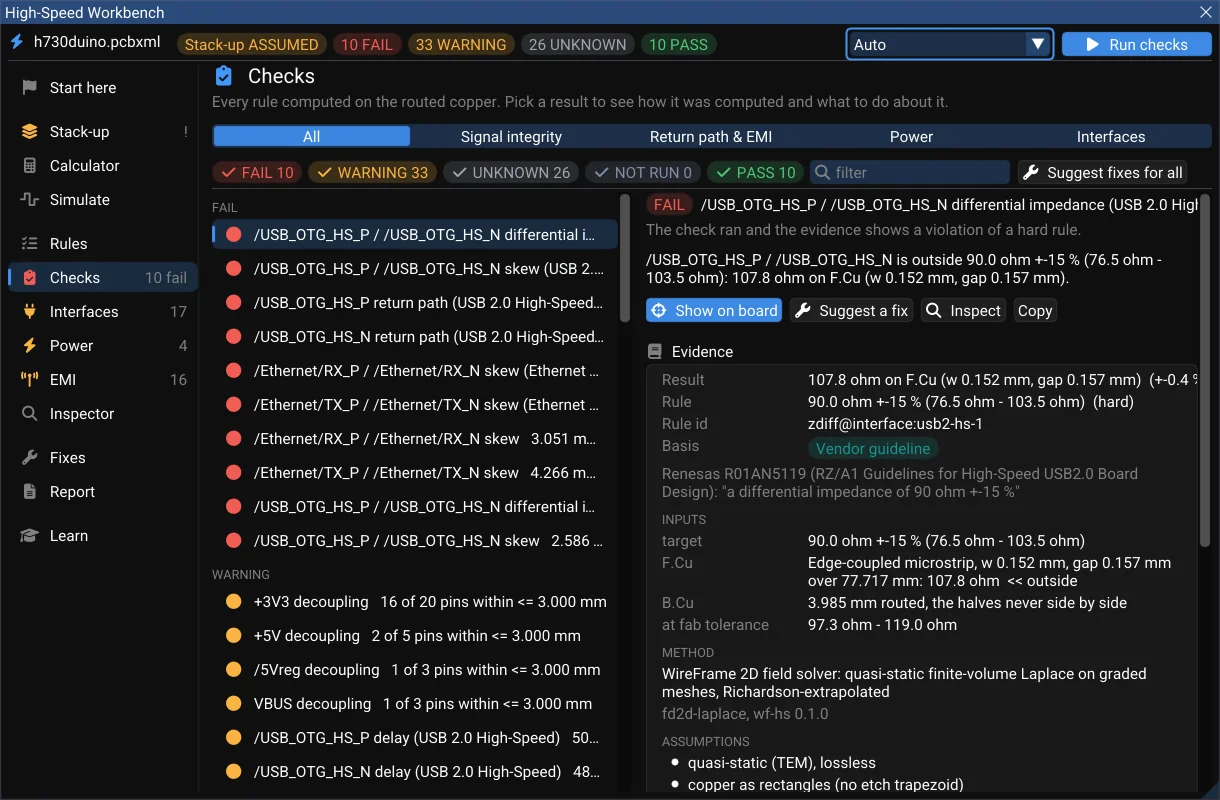
Most rule checks answer pass or fail. That is not enough for a fast signal: you need to know what was measured, against which limit, where that limit comes from, and what the tool assumed. Otherwise a green tick on an assumed stack-up is worth exactly as much as no check at all.
This post runs WireFrame's High-Speed Workbench (in the beta of the next release) on h730duino — an open-source, 4-layer STM32H730 board in the Arduino Mega format by Martin Ribelotta (MIT licence), with USB 2.0 High-Speed and two Ethernet ports.
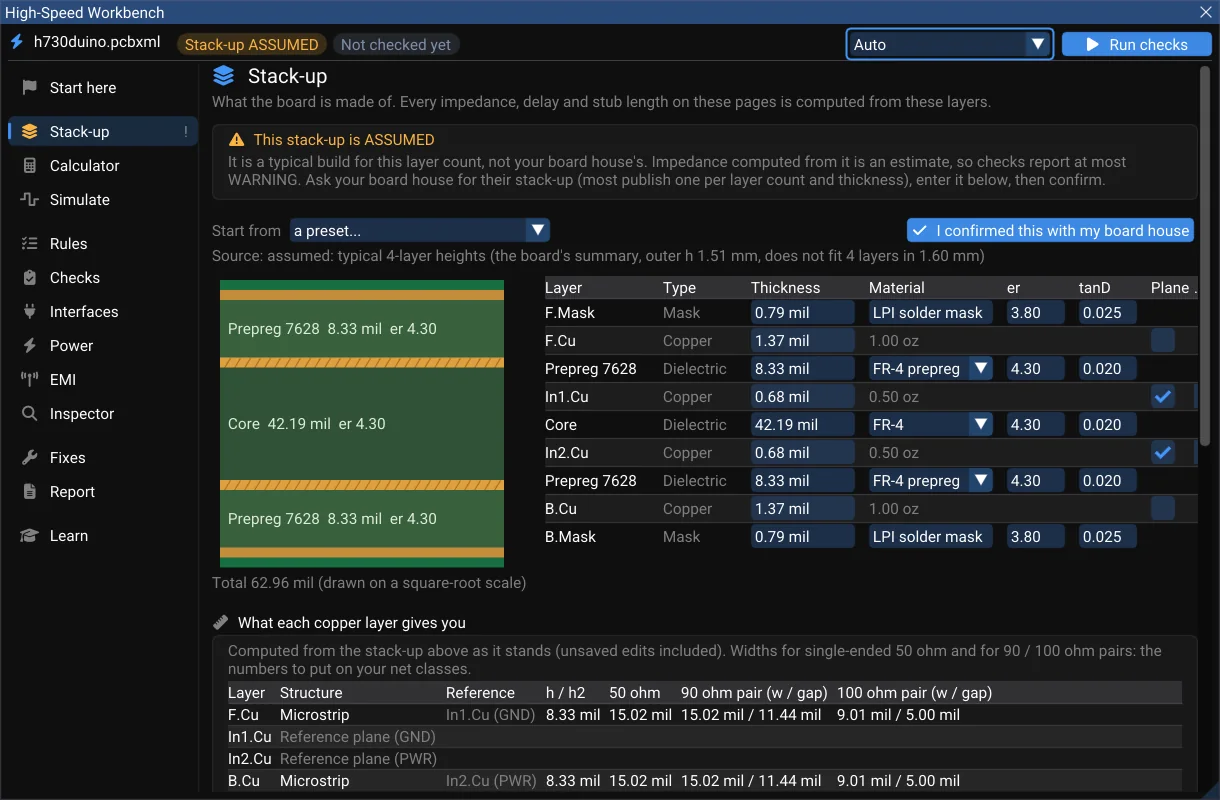
The KiCad files carry no stack-up from a board house, so WireFrame builds a typical 4-layer one and marks it ASSUMED. That single word matters: until someone confirms the stack-up, no result on the board can be better than WARNING.
The table at the bottom already answers a routing question: on F.Cu, over the In1.Cu ground plane, a 90 Ω differential pair needs about 15.0 mil wide and 11.4 mil apart.
WireFrame reads the net names and recognises 30 fast signals: USB_OTG_HS, the Ethernet pairs, RGMII, OCTOSPI and SDMMC. You review the proposals — impedance targets, pairs, length groups, interfaces — and accept what is right.
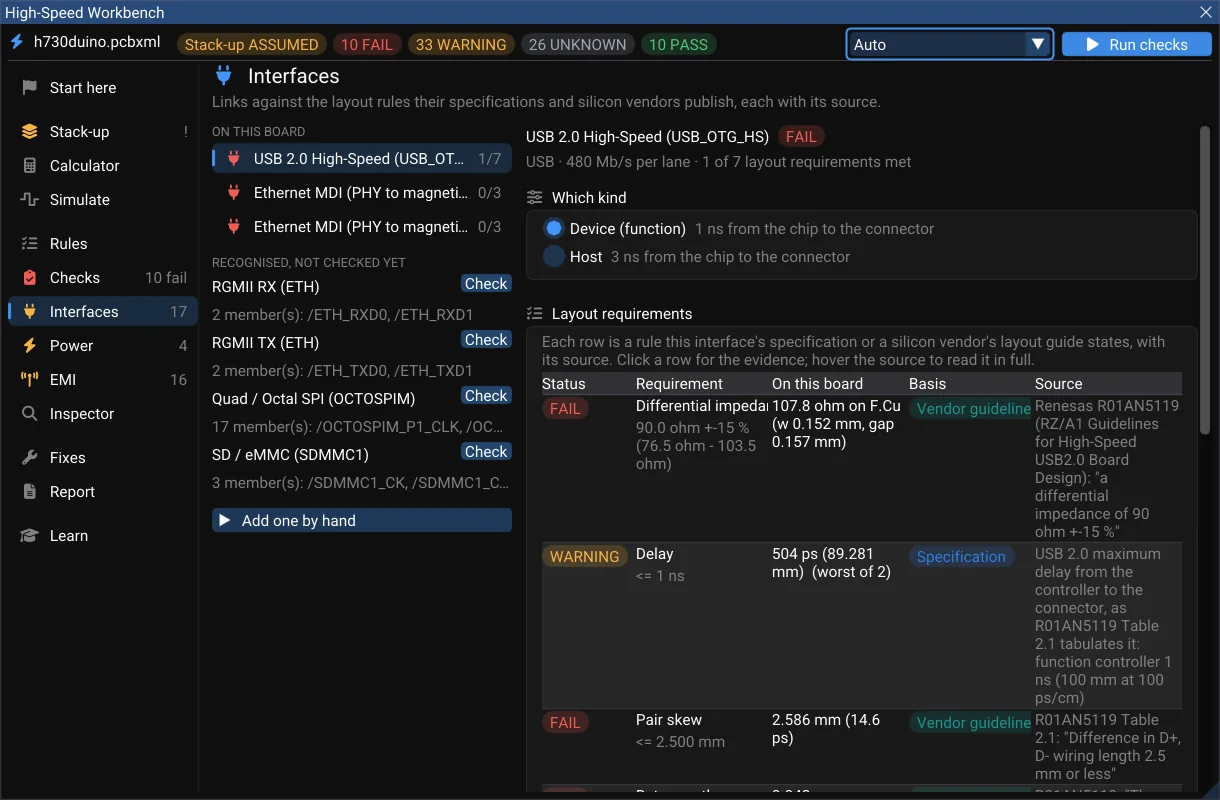
Interfaces checks USB 2.0 HS against all of its published layout requirements at once, each row cited: 90 Ω ±15 %, 2.5 mm skew, no vias, a plane 1 mm wider than the pair, 3 × S guard. On this board, USB meets 1 of 7 and the two Ethernet MDI ports 0 of 3.
Layout compliance is necessary, not sufficient — the electrical test of the standard decides — and the Workbench says so wherever it uses the word.
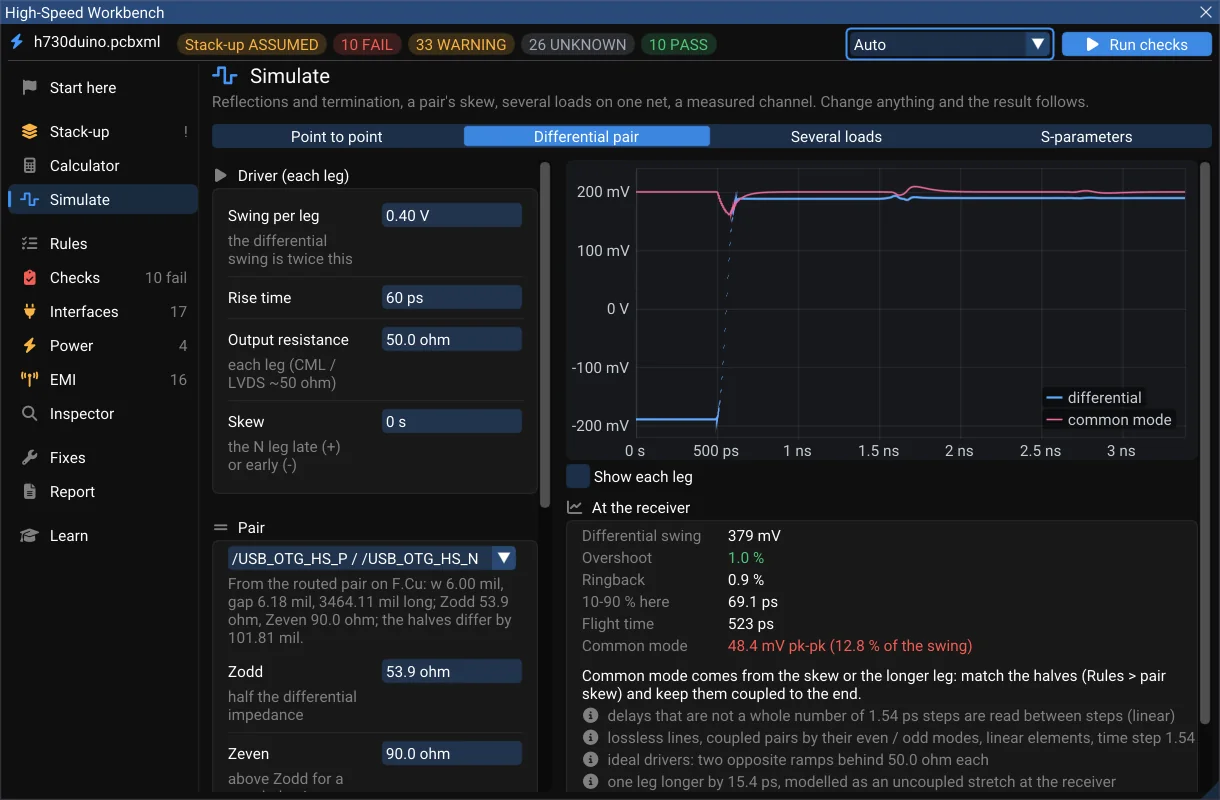
The Simulate page reads the routed pair directly. Its two halves differ by 15.4 ps. At the receiver that becomes 48.4 mV of common mode — 12.8 % of the swing — while the differential signal itself looks clean (1 % overshoot).
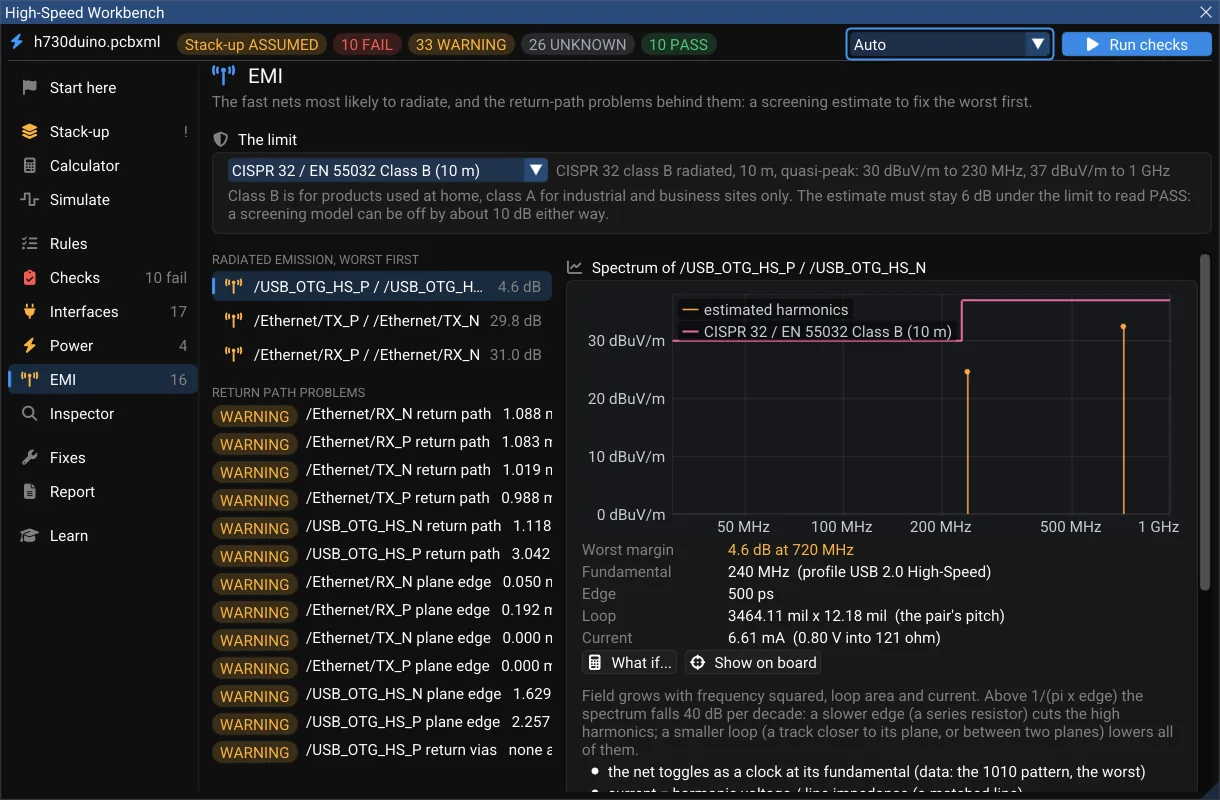
Common mode is what radiates. The EMI page agrees: the USB pair sits only 4.6 dB under the CISPR 32 class B limit at 720 MHz — the third harmonic of 240 MHz. It is a screening estimate (closed-form models can be ±10 dB), which is exactly what it is for: fixing the worst offender first.
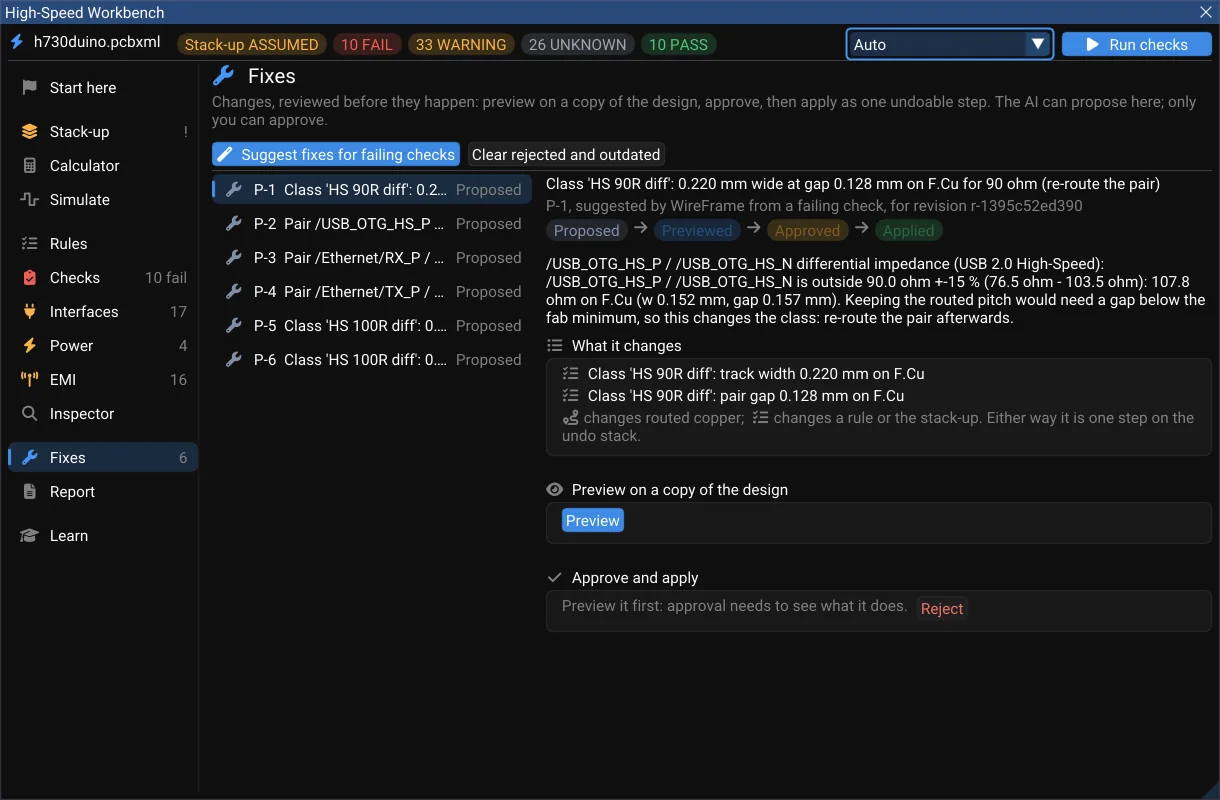
Suggest a fix turns the failure into a change: make the class HS 90R diff 0.220 mm wide with a 0.128 mm gap on F.Cu. Preview runs the checks again on a copy of the design; only a person can Approve; Apply is one undo step. The AI Copilot can propose fixes on these pages too — it cannot approve them.
A high-speed review is a conversation between a designer, a reviewer and sometimes a customer. Numbers without their basis start arguments; numbers with their method, assumptions and source end them. The Workbench's Report writes all of it down — in HTML with figures, Markdown or JSON — including what was not checked.