PCB design, AI & WireFrame
Practical guides on board design, high-speed routing, moving from KiCad, sample boards and AI-assisted electronics.
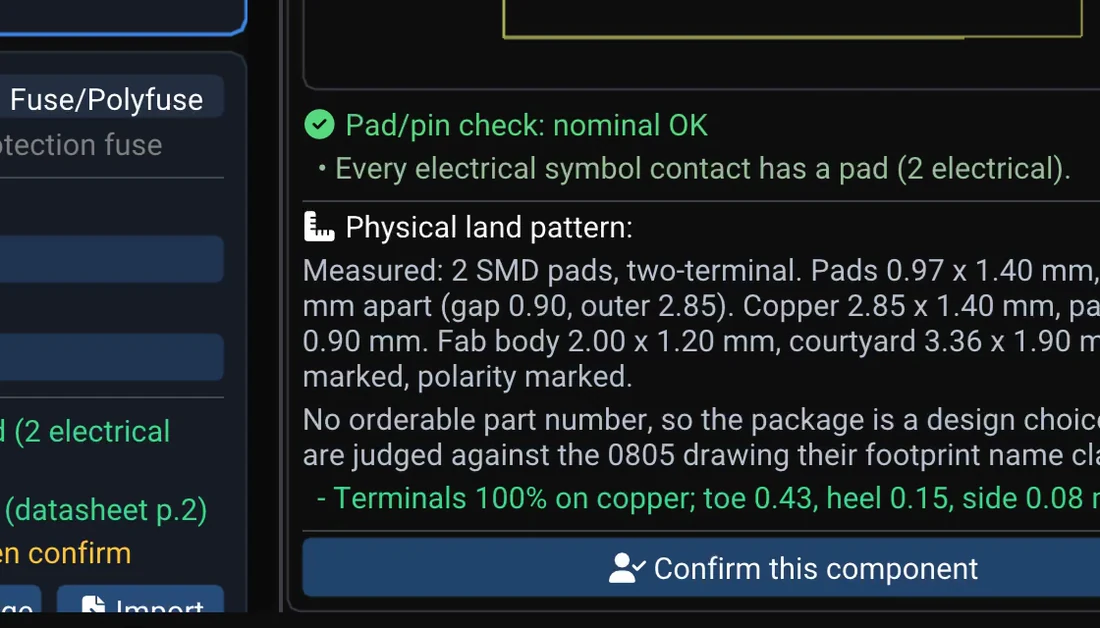
What an AI copilot for PCB design should and should not do
Seven rules for an AI that edits your schematic and board: datasheet evidence, a plan before an edit, work on a copy, and a person who approves.
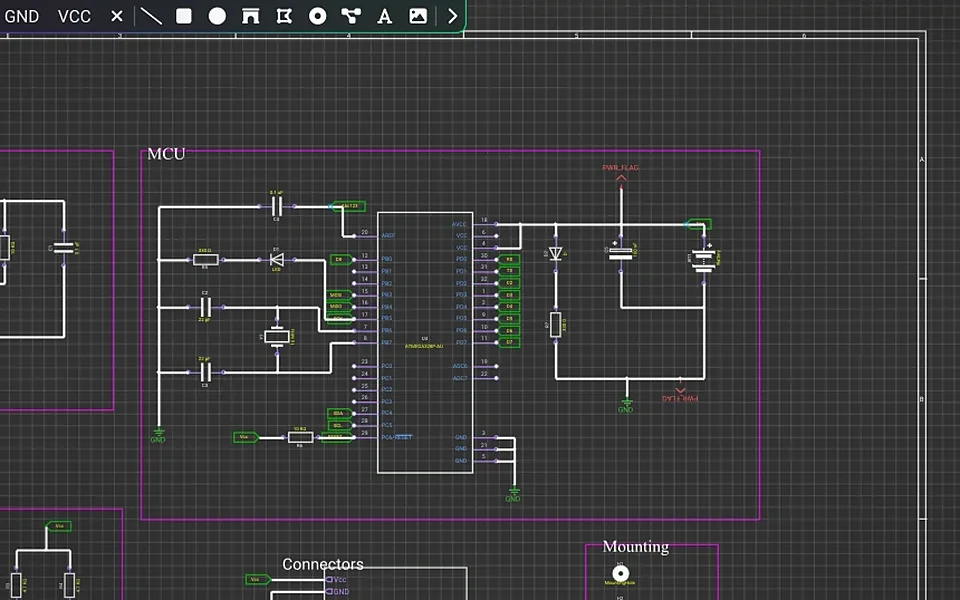
KiCad to WireFrame EDA and back: 72/72 round trips identical
Open a KiCad project in WireFrame EDA, work on it and export it back to KiCad: what comes across, what to check, and how the round trip was measured.
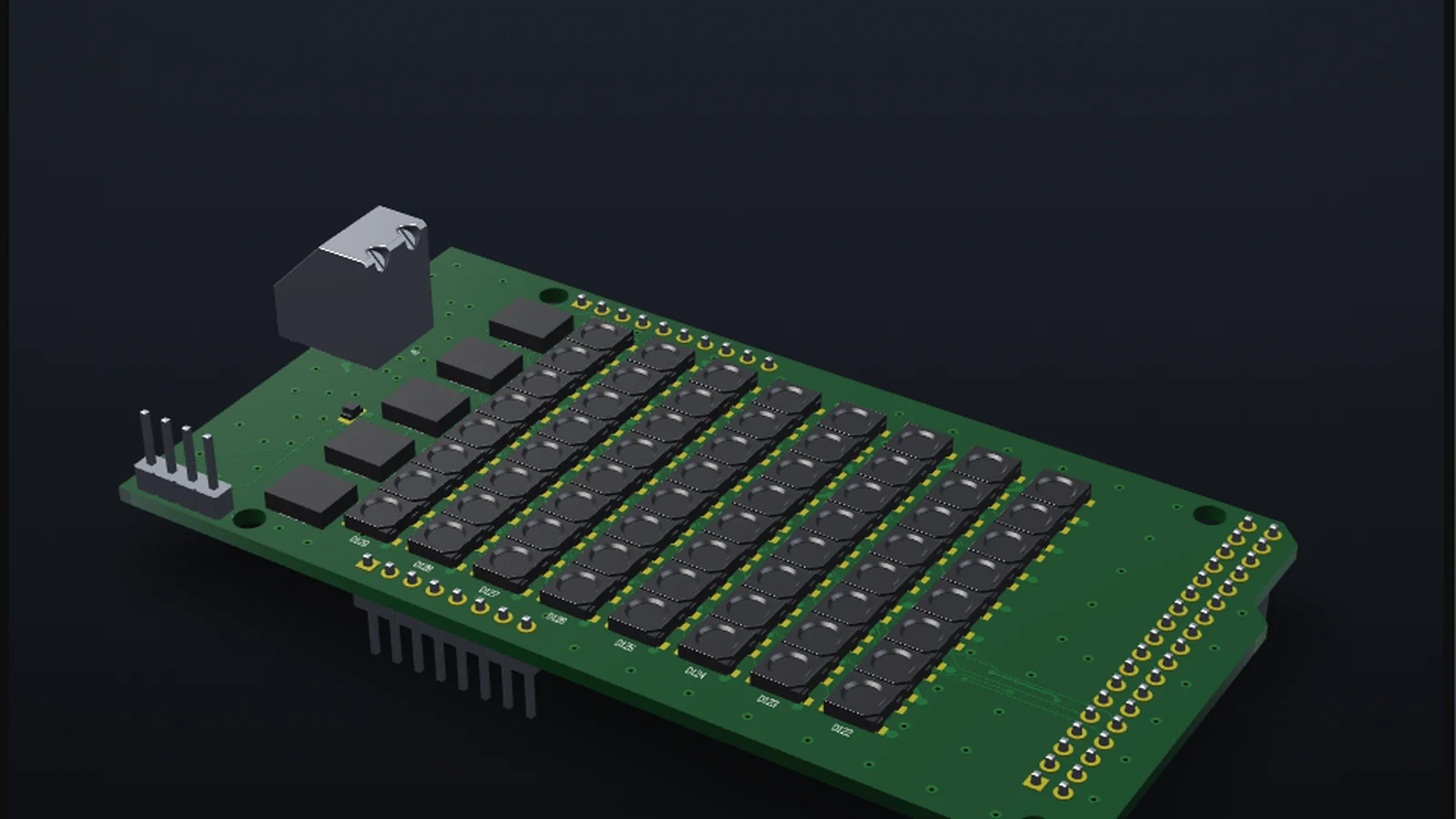
How to design a PCB with Claude over MCP in WireFrame EDA
Connect Claude, Codex or Cursor to WireFrame EDA over MCP and let your own agent design the board you have open: setup, the Allow step, what is counted.
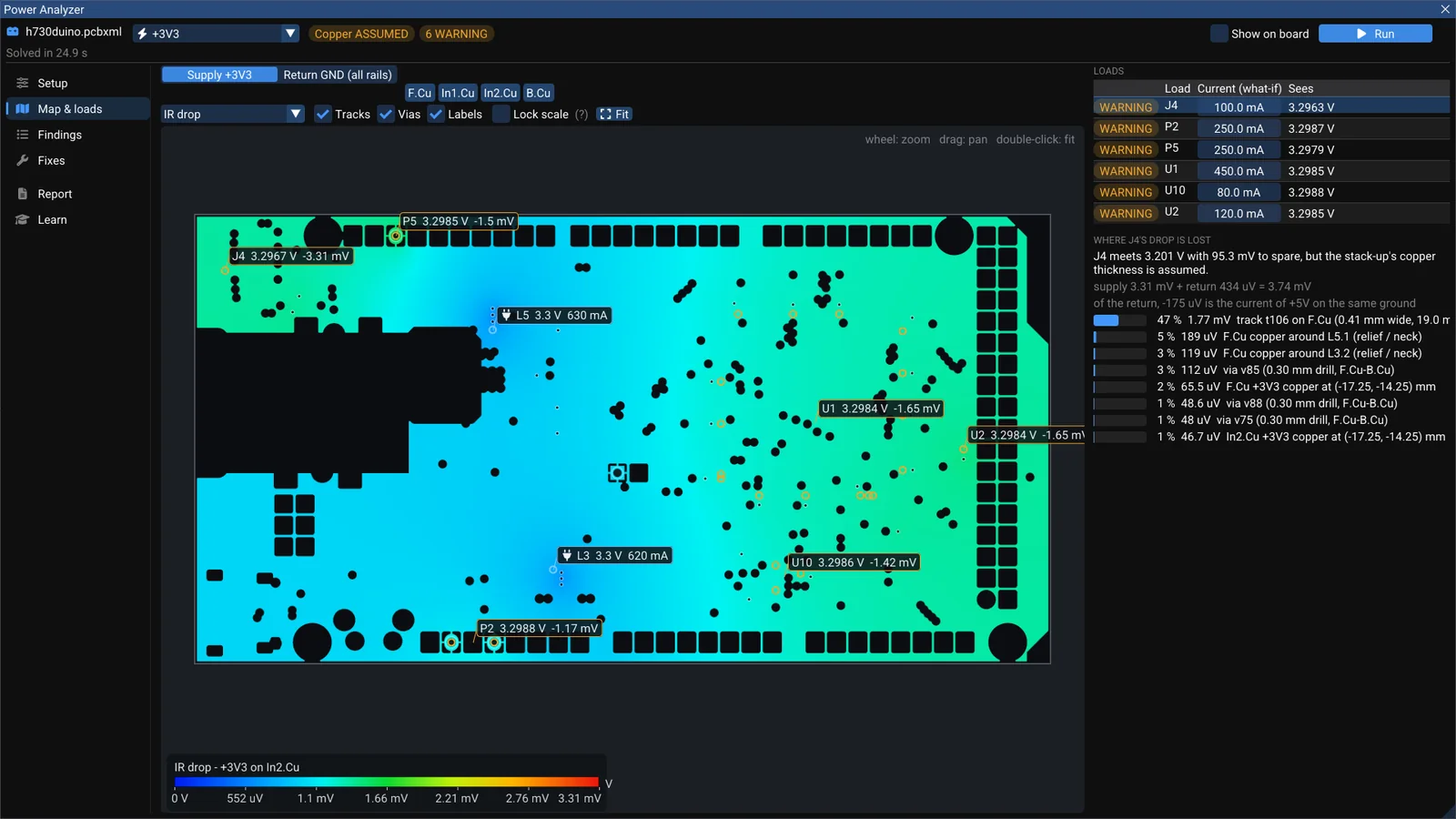
Where does your 3.3 V go? DC IR drop on a real board
WireFrame's Power Analyzer solves a rail's real copper — supply and return — and splits each load's voltage drop exactly over the tracks, necks and vias that cause it. A walk through the +3V3 rail of the open-source h730duino.
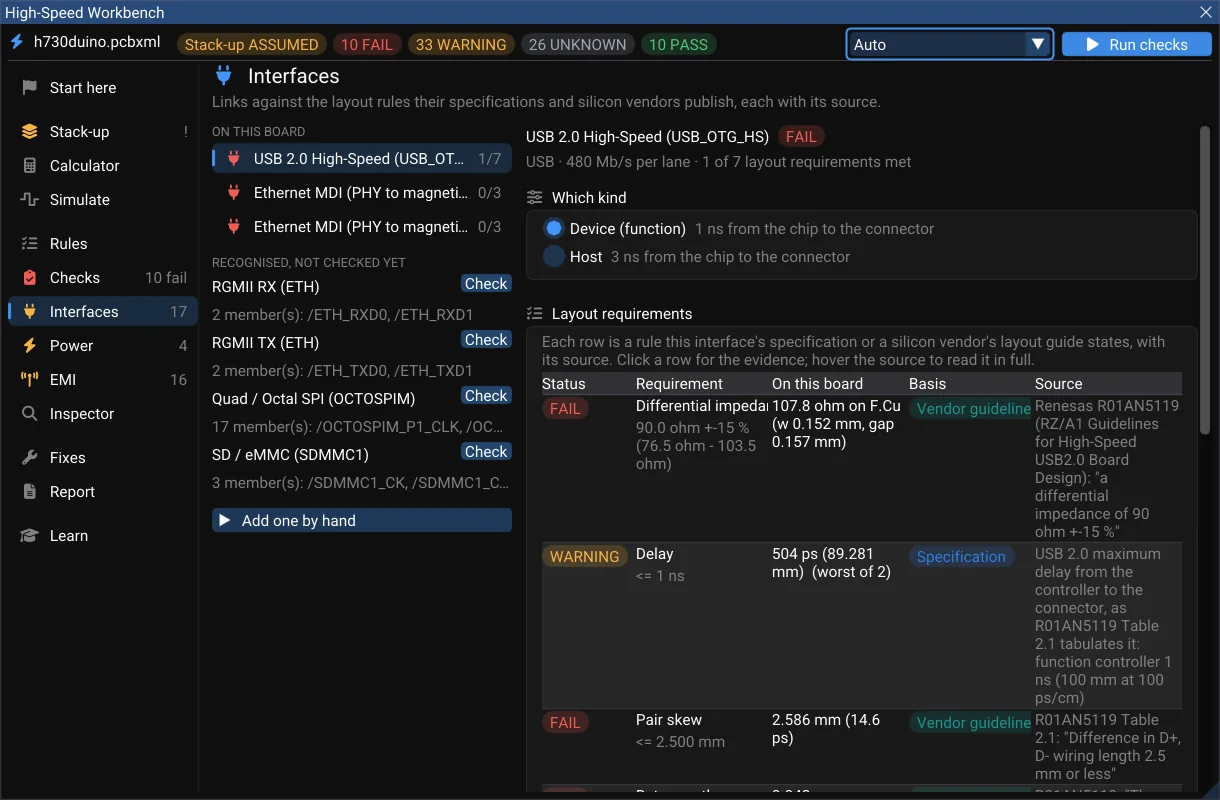
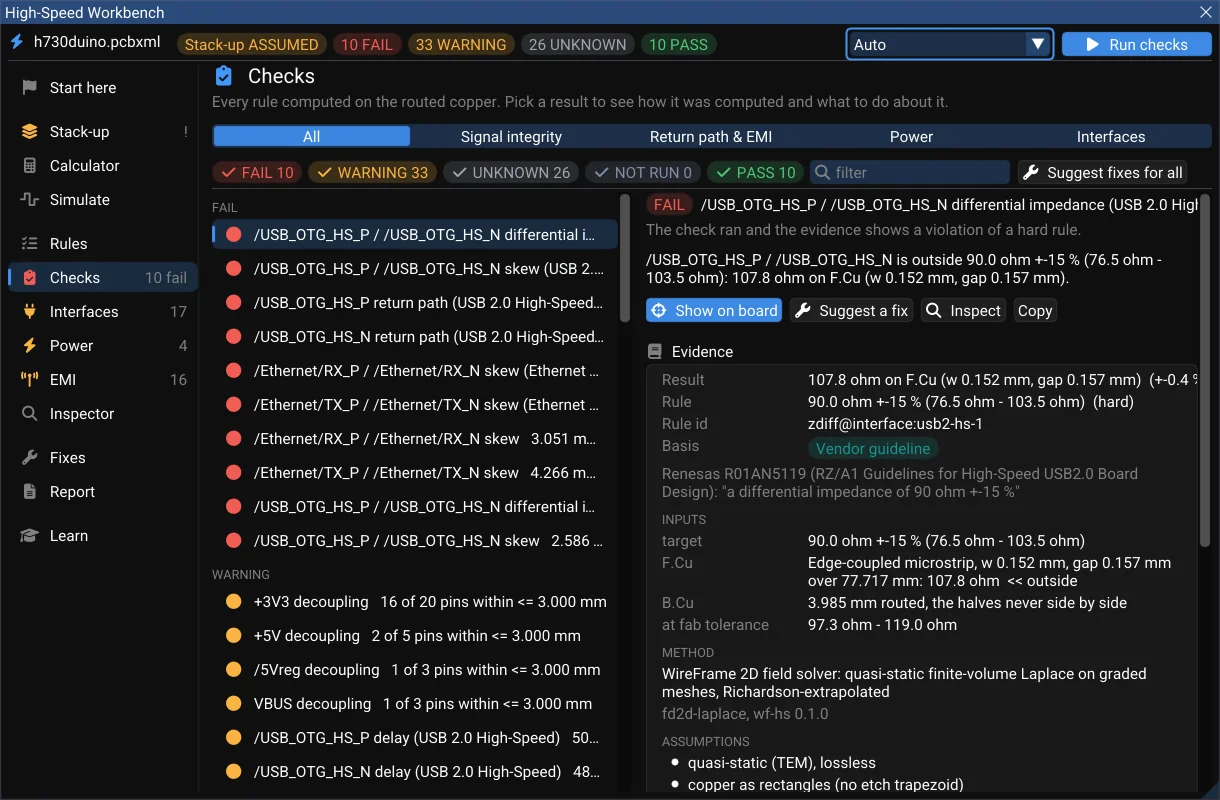
A USB pair at 107.8 Ω — high-speed checks that show their evidence
Running WireFrame's High-Speed Workbench on the open-source h730duino board — the USB 2.0 pair's impedance, skew and common mode, its EMI margin, and the fix — with the method and the source behind every number.
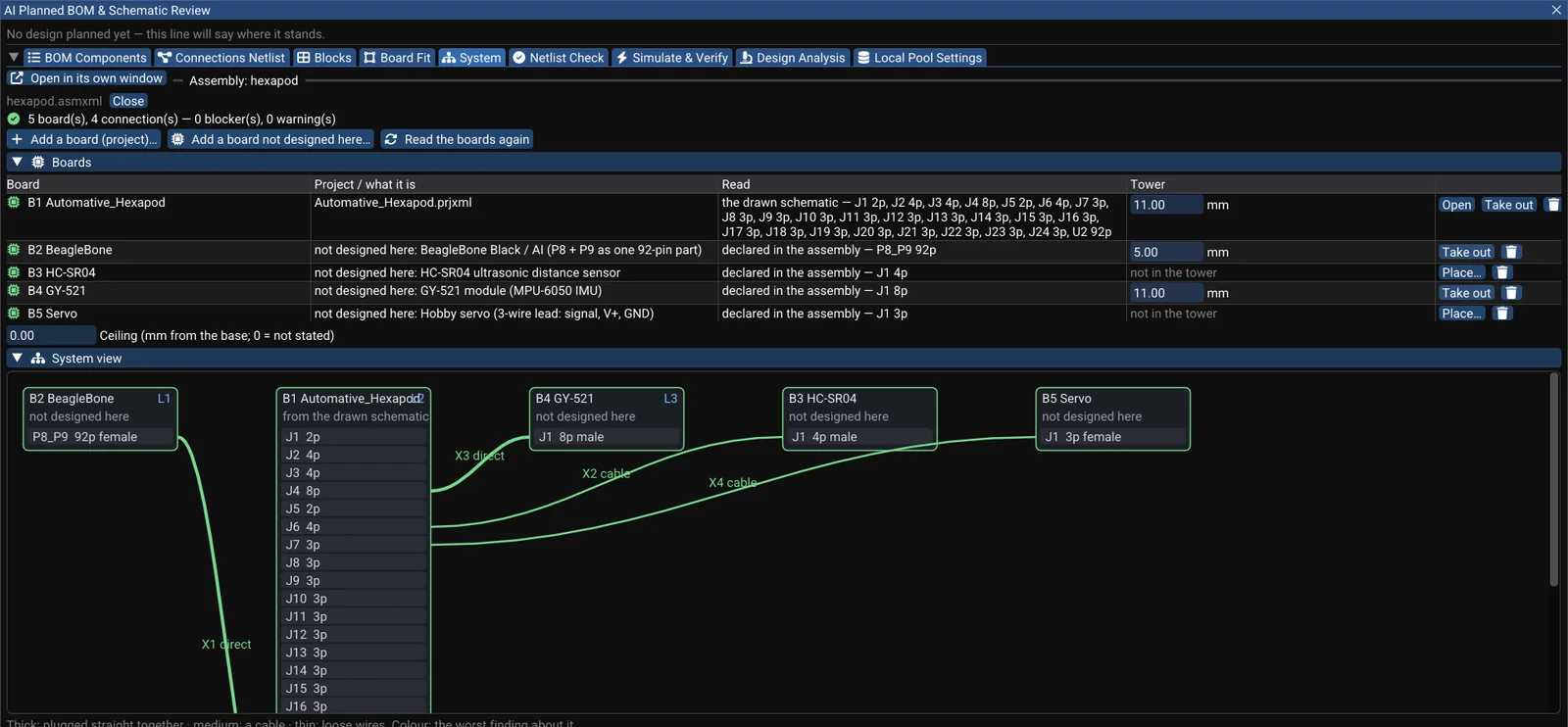
One product, many boards — every connection checked pin by pin
A HAT on a Raspberry Pi, a cape on a BeagleBone, a front panel on a cable — WireFrame treats a product of several boards as one project and checks every connection between them, bought boards included. Shown on an open-source hexapod robot's BeagleBone AI cape.
WireFrame EDA development update — October 2026
What WireFrame 2.0 brings, written in October 2026 before it shipped — the AI Copilot measured on 20 designs, a High-Speed Workbench and a Power Analyzer that show their evidence, multi-board products, KiCad/Altium/EasyEDA exchange, and what is still being built.
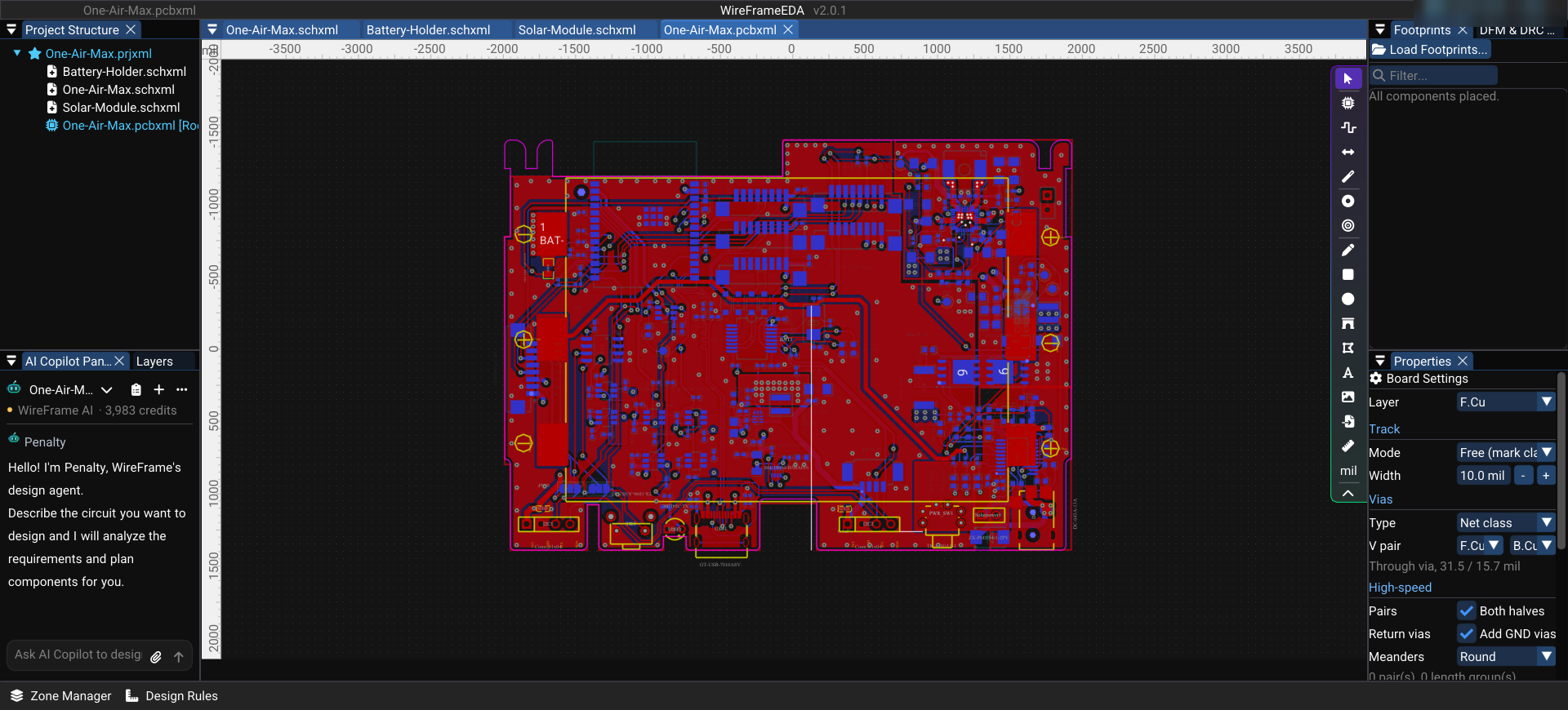
Sample board One-Air-Max — a 4-layer ESP32-C6 air-quality sensor with a PCB antenna, in WireFrame EDA
KiCad's One-Air-Max demo (ESP32-C6, solar and battery charging, buck converter, sensor front-end) imported into WireFrame EDA — its four-layer stackup and the keepout that keeps copper away from the antenna.
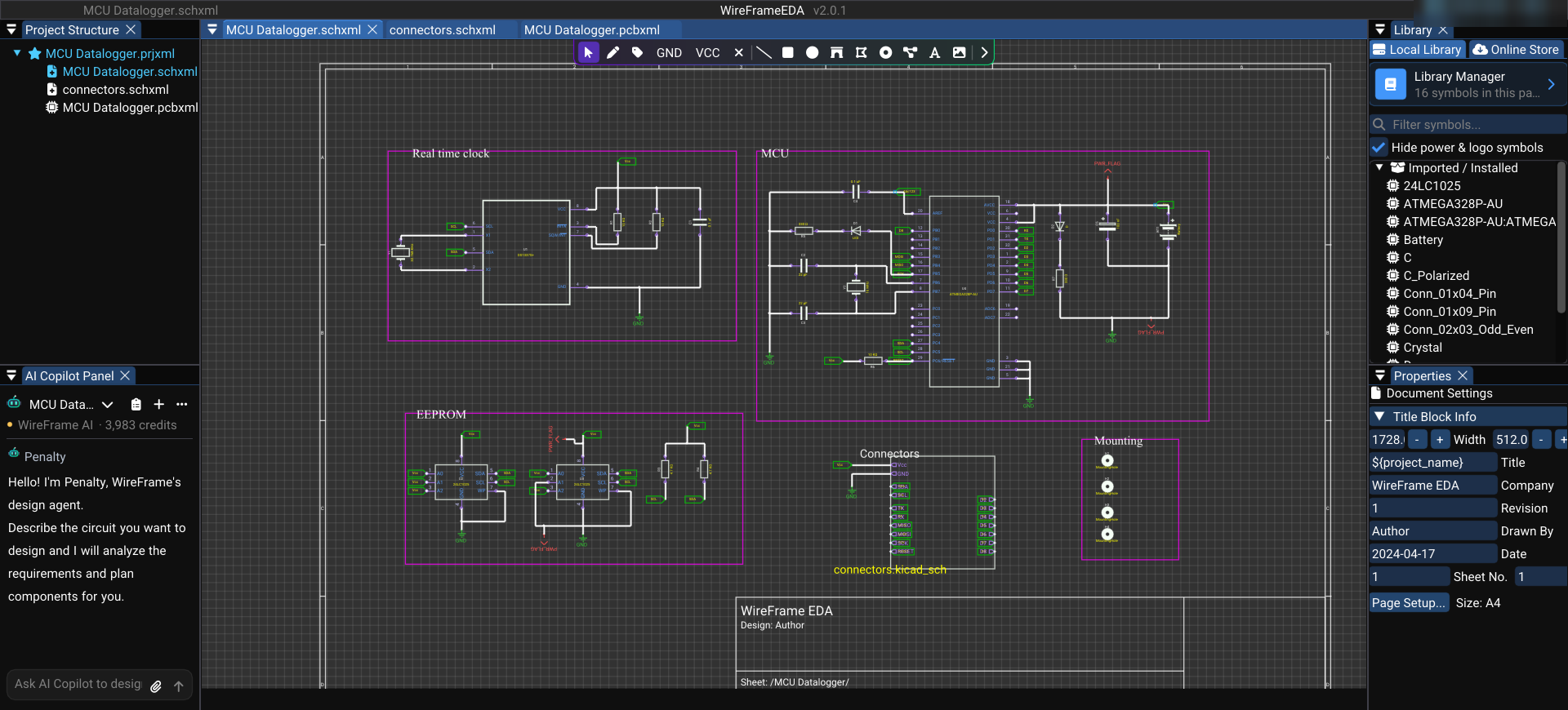
Sample board KLP4e MCU datalogger — reading a finished schematic, and what ERC says about it
The ATmega328P datalogger from "KiCad Like a Pro" (4th ed.), imported into WireFrame EDA — its two schematic sheets, why a working design still shows 18 ERC errors, and the small two-layer board.
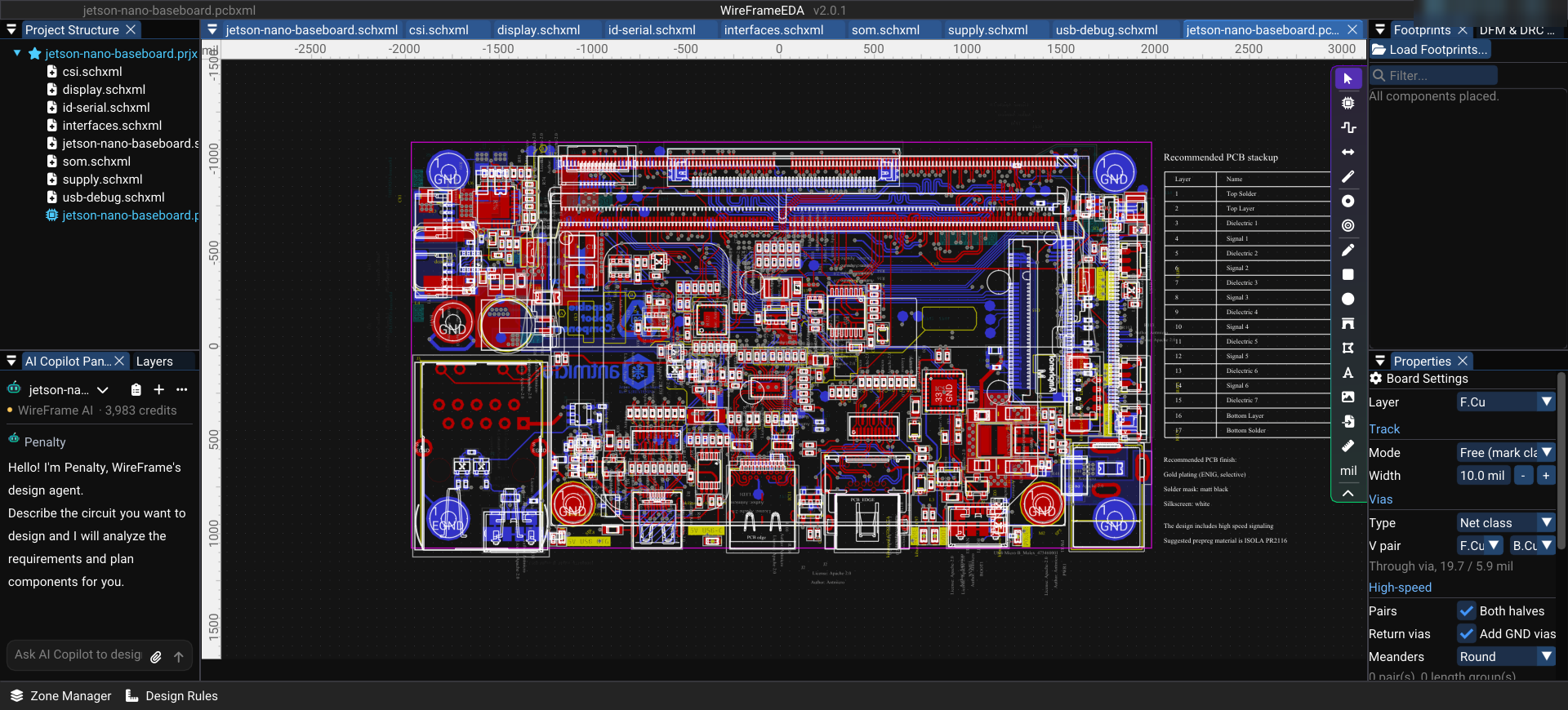
Sample board Jetson Nano baseboard — an 8-layer SO-DIMM carrier, opened in WireFrame EDA
Antmicro's open-source baseboard for the Jetson Nano and Xavier NX modules, imported from KiCad into WireFrame EDA — what is on its eight layers and what WireFrame measures on it.
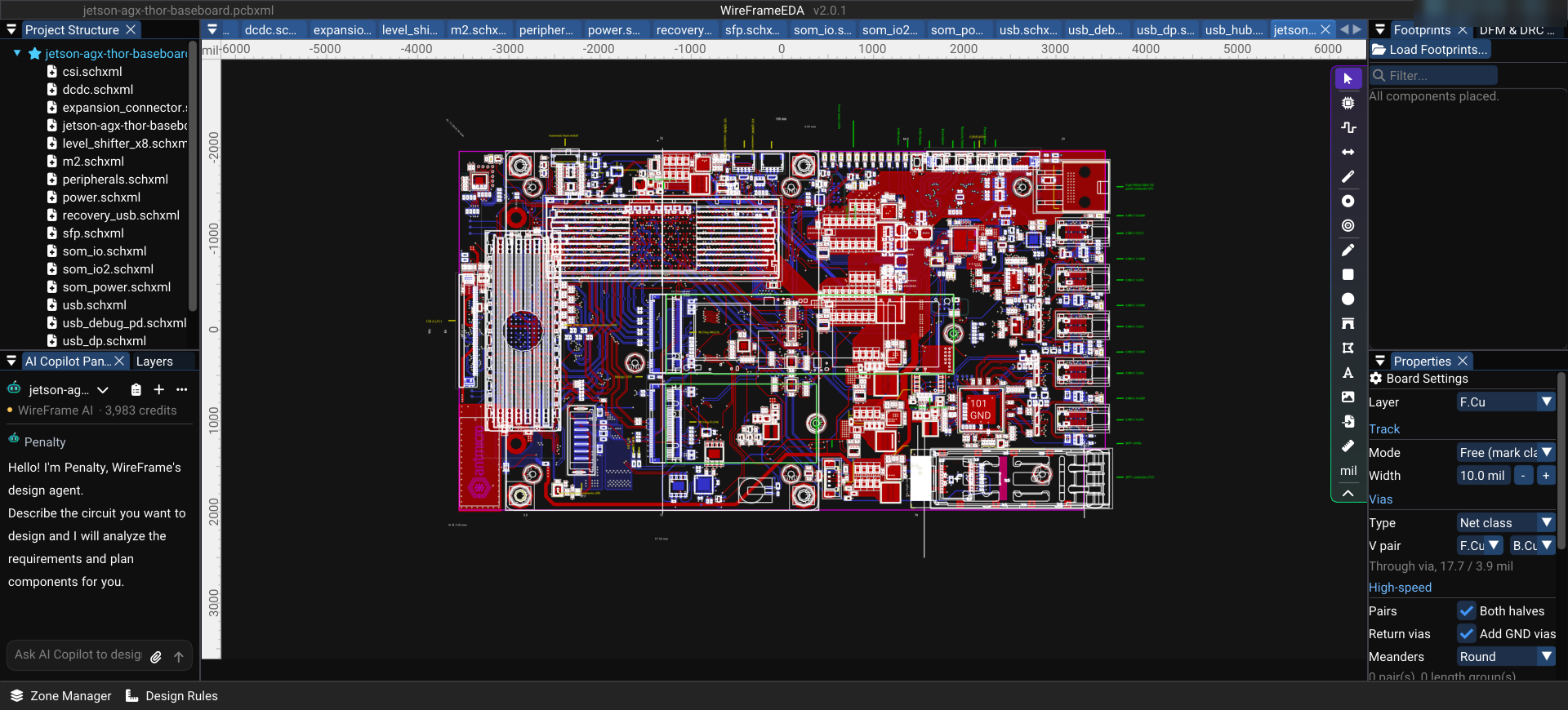
Sample board Jetson AGX Thor baseboard — 10 layers and 1124 parts, opened in WireFrame EDA
Antmicro's open-source carrier for the NVIDIA Jetson AGX Thor module, imported from KiCad into WireFrame EDA — its ten-layer stackup, length-tuned camera pairs and the numbers WireFrame measures on it.
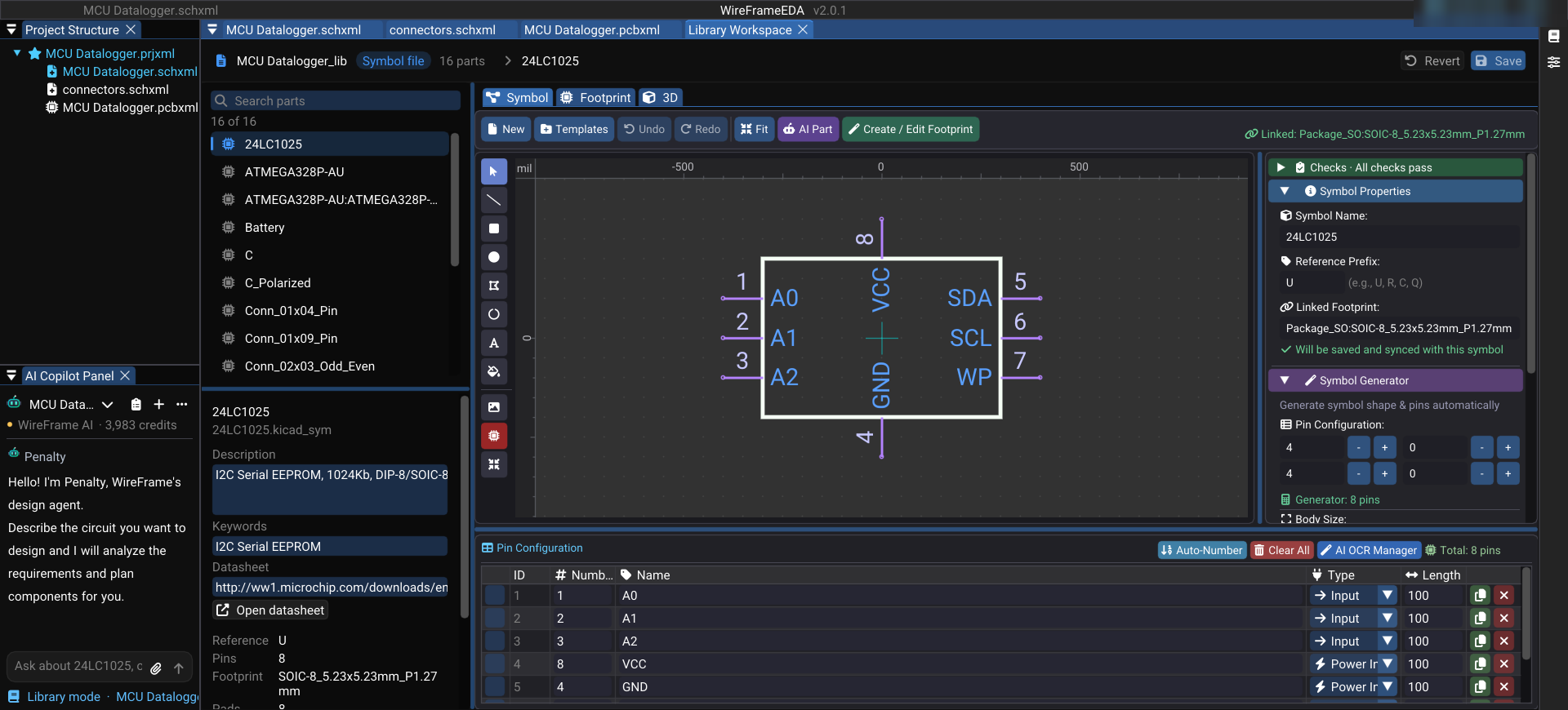
How WireFrame finds the right part for every BOM row
Where WireFrame looks for a symbol and land pattern, the checks every candidate must pass, why a part you confirm is reused on the next board — and how the AI Copilot reads the same library instead of guessing.
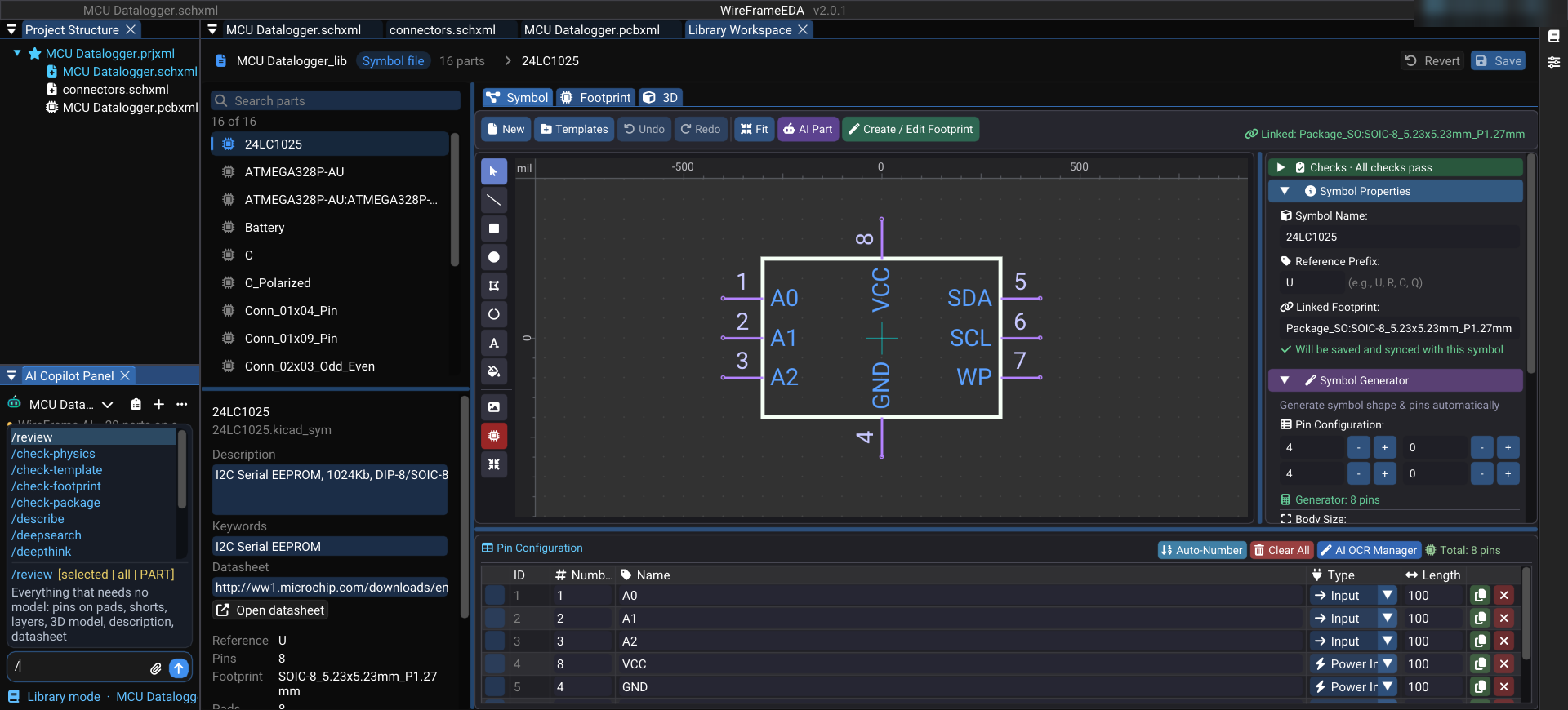
Copilot commands, panel by panel
What the AI Copilot's / commands do on a schematic, a PCB, the simulation workbench and the Library Workspace — what each one is for, which ones need no model at all, and why the list changes with the panel in front.
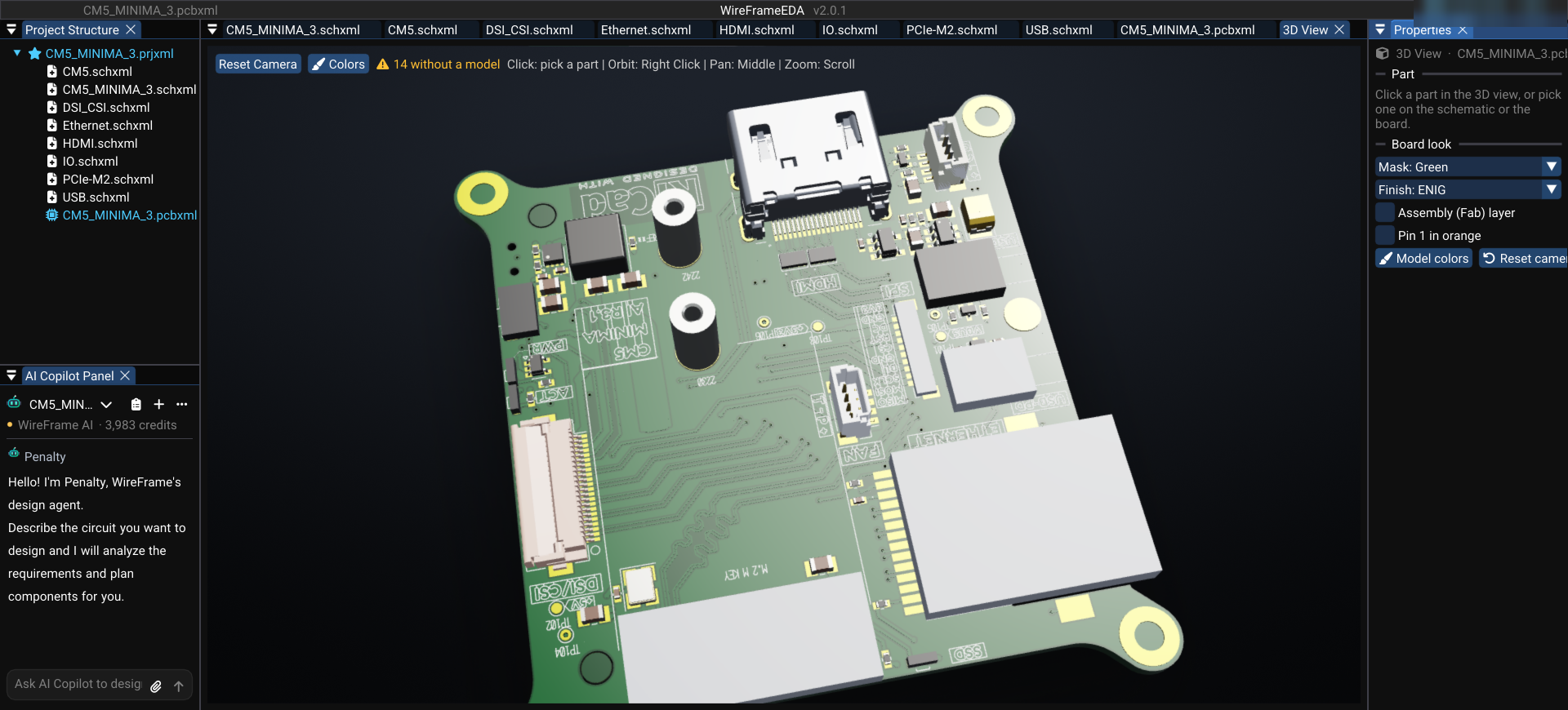
Sample board CM5 Minima — a 6-layer Raspberry Pi CM5 carrier, in 2D and 3D in WireFrame EDA
The CM5 Minima carrier for the Raspberry Pi Compute Module 5, from KiCad's demo projects, imported into WireFrame EDA — four inner planes, an M.2 slot, and the parts drawn from their 3D models.
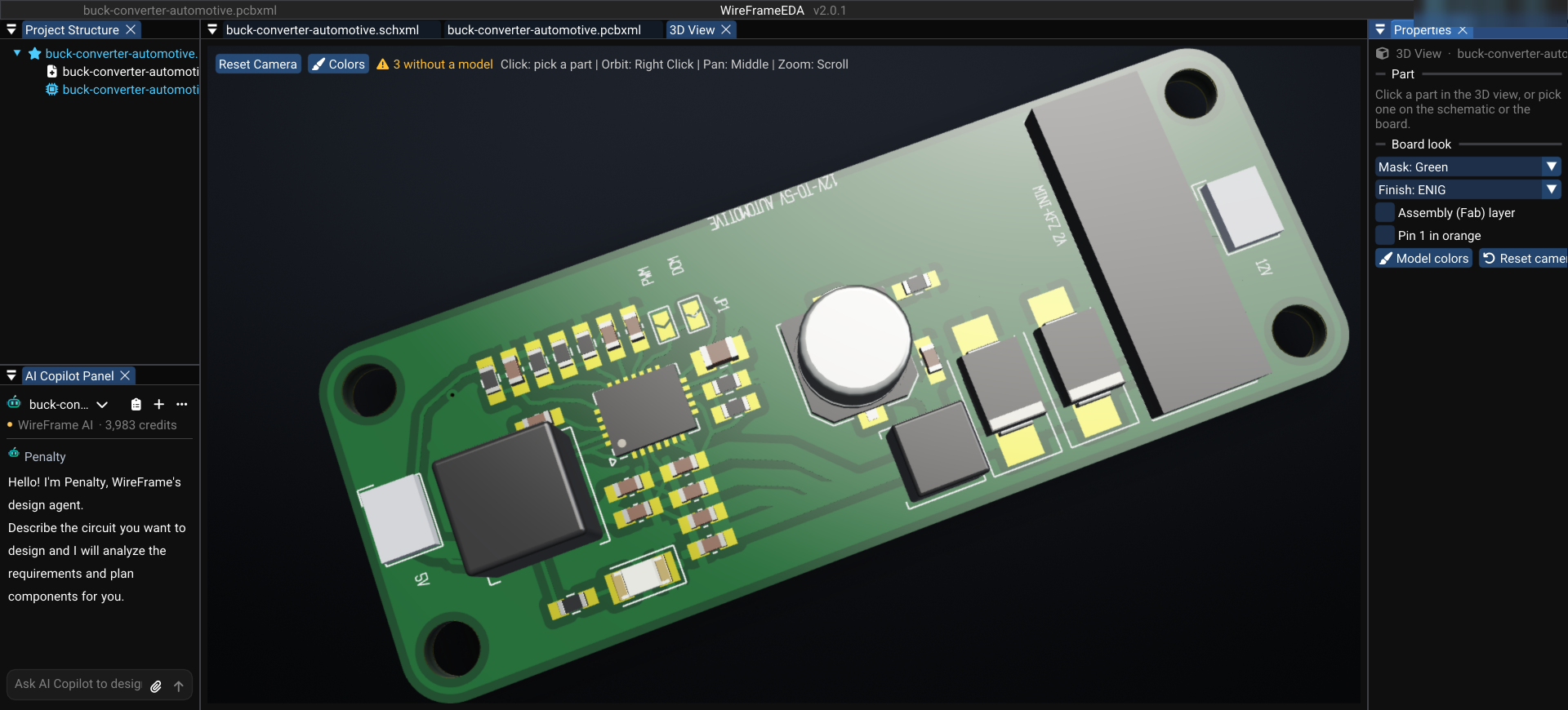
Sample board automotive buck converter — 12 V to 5 V on two layers, in WireFrame EDA
A small open-source MAX17574 buck converter for 12 V vehicles, imported from KiCad into WireFrame EDA — fully routed, ground poured on both sides, clean DRC, and what to look at on a board this size.
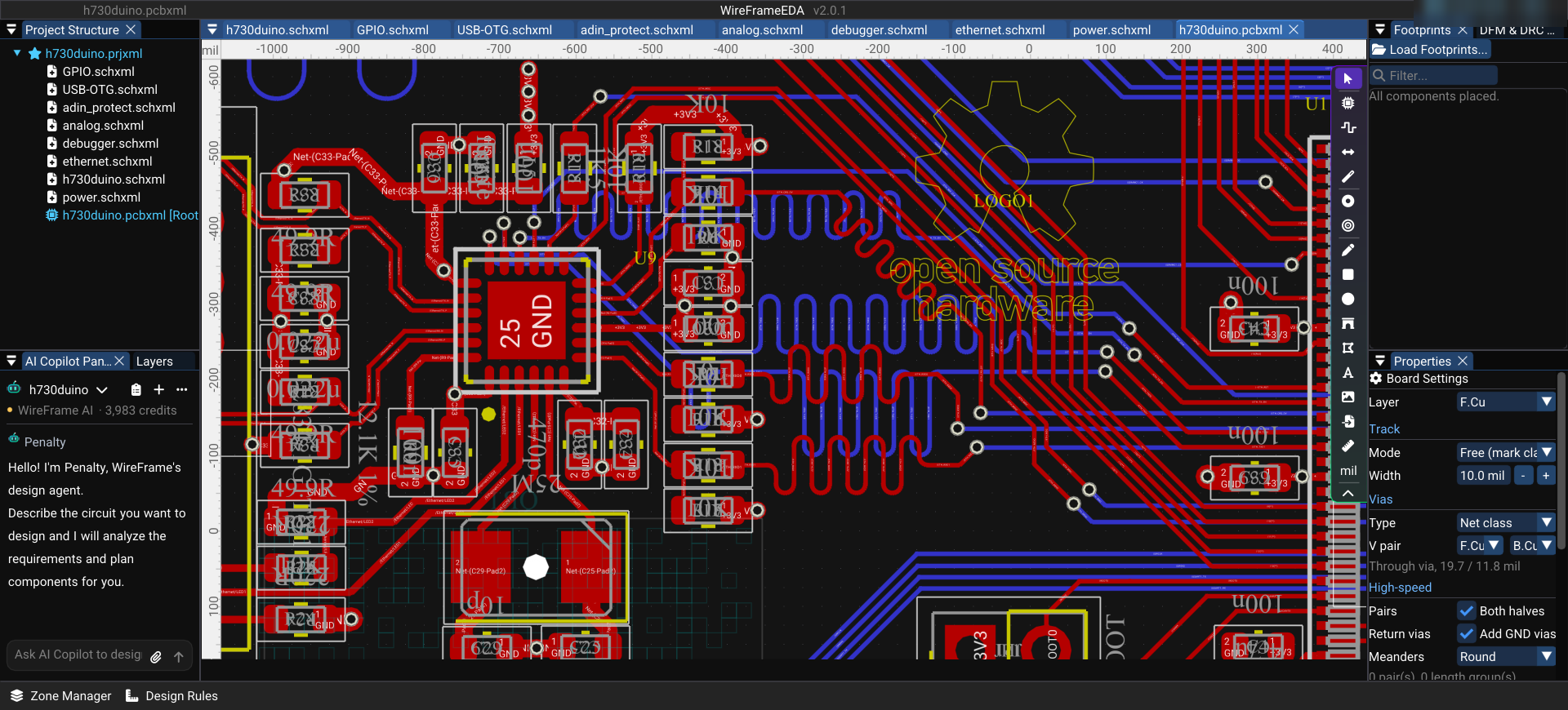
Length matching in practice — RMII and SDMMC on the H730duino
Measuring the real routed lengths of the RMII Ethernet and SDMMC traces on the open-source H730duino board: seven RMII signals matched within 0.02 mm. Why, and when you don't need to.
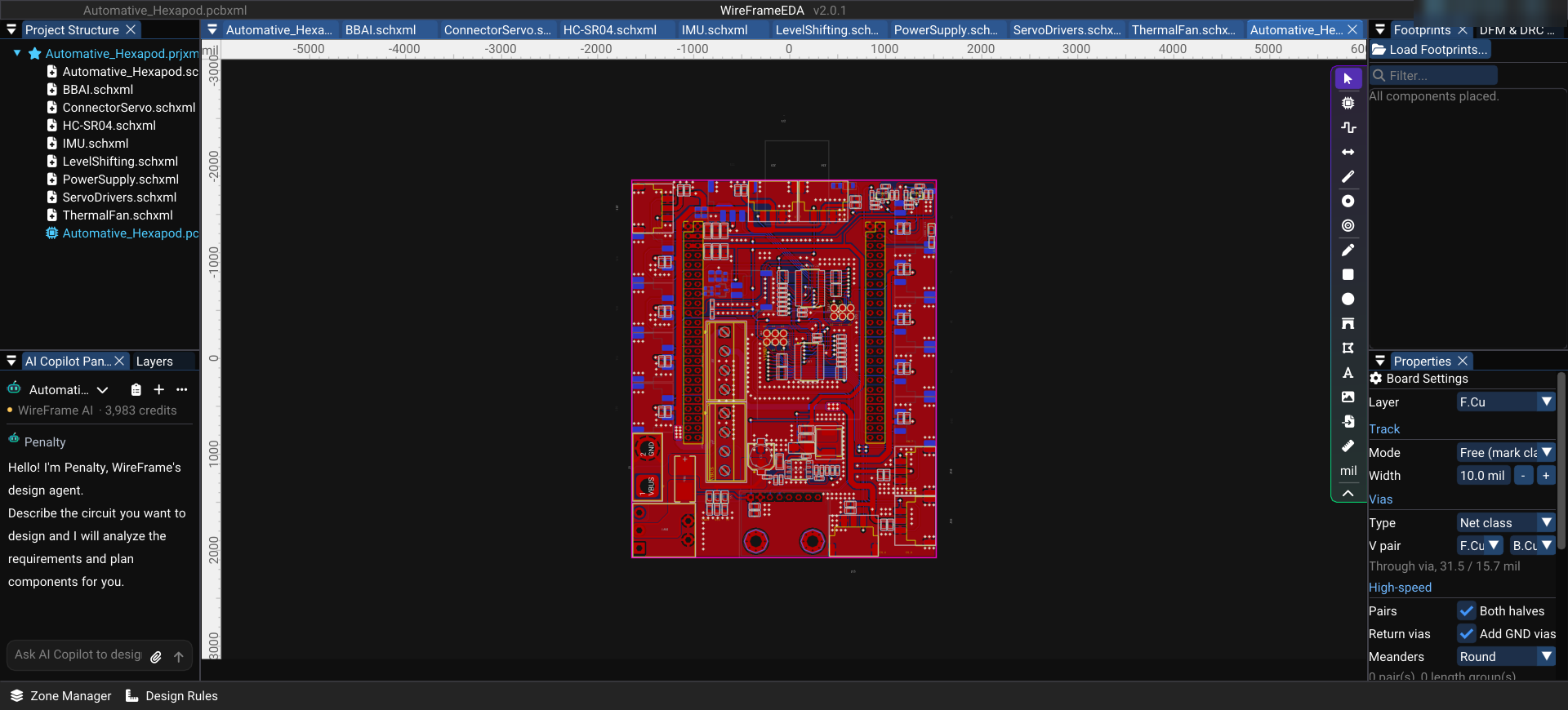
Hardware design walkthrough: 18-servo hexapod robot main board on BeagleBone AI
Reading the main board of the open-source reinforcement-autonomous-hexapod robot: BeagleBone AI, two PCA9685 driving 18 servos, an MPU6050 IMU, an ultrasonic sensor and a TPS54331 supply — opened in WireFrame EDA.
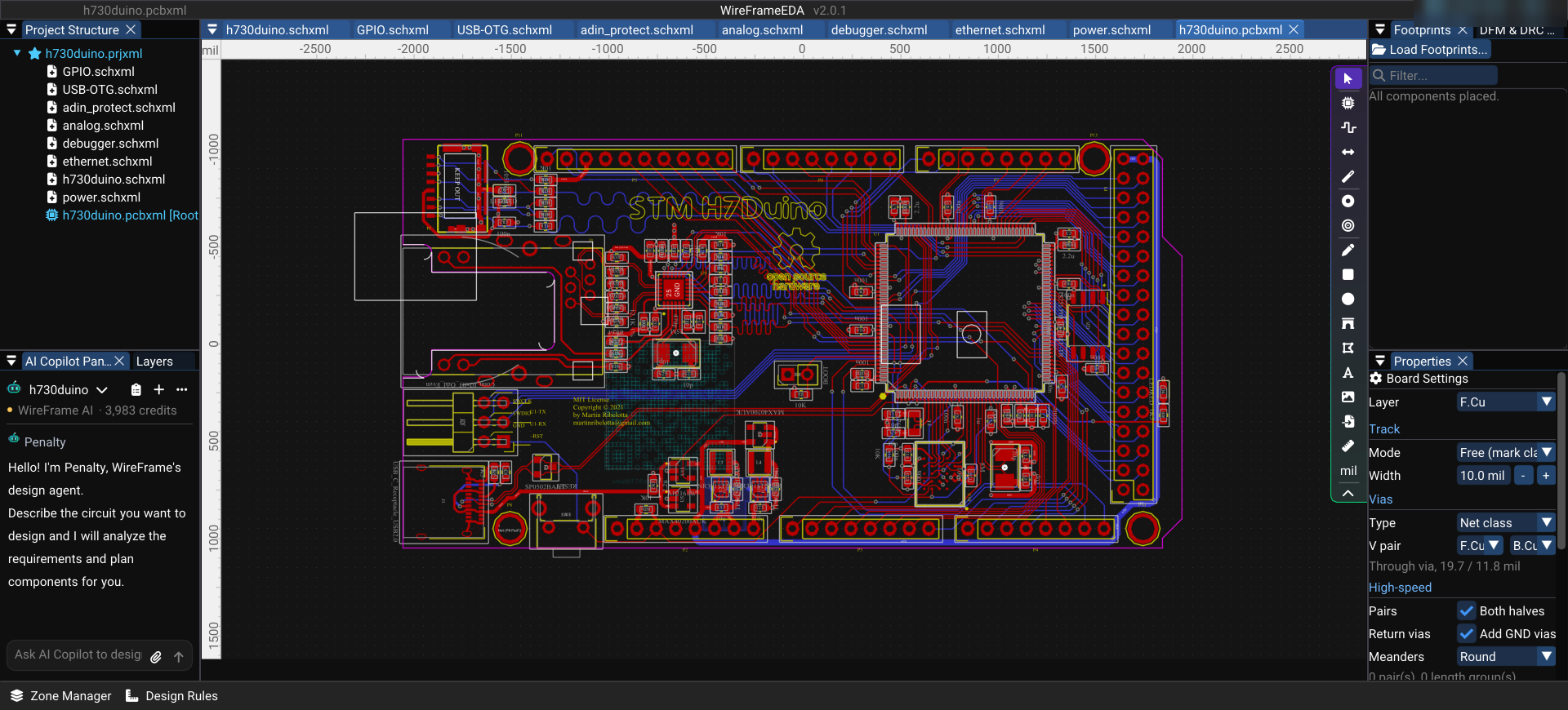
Sample board H730duino — a 4-layer STM32H730 Arduino Mega-format board, opened in WireFrame EDA
Opening the open-source KiCad project H730duino (STM32H730, Ethernet, HyperRAM, USB-C) in WireFrame EDA to read its 4-layer stackup, GND/3V3 planes, length-matched meanders and board metrics.
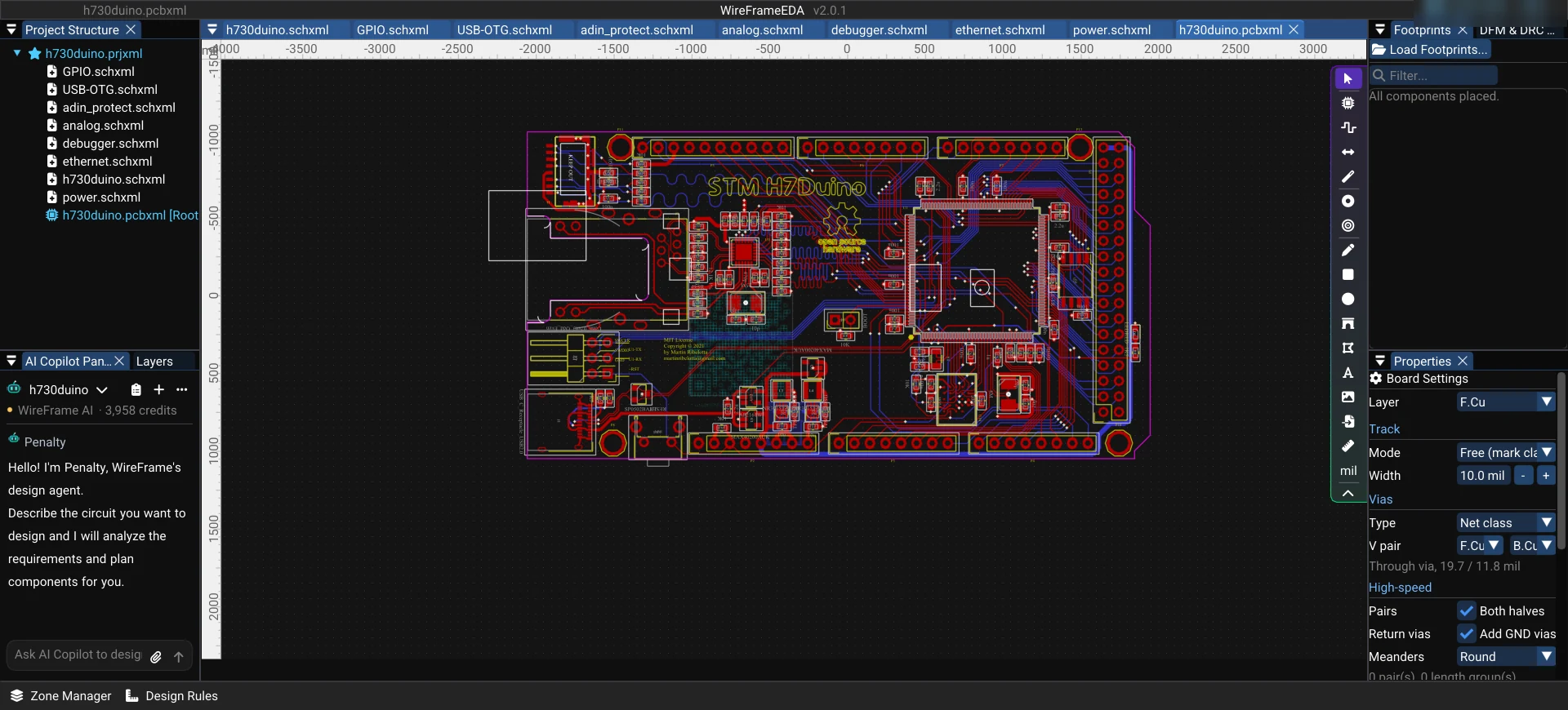
What is WireFrame EDA? A modern AI-assisted PCB design tool
WireFrame EDA is a desktop PCB design application for Windows, macOS and Linux — schematic, layout, 3D, Gerber export and SPICE simulation — with an AI Copilot (Pro and Max) that drafts schematics from a description.
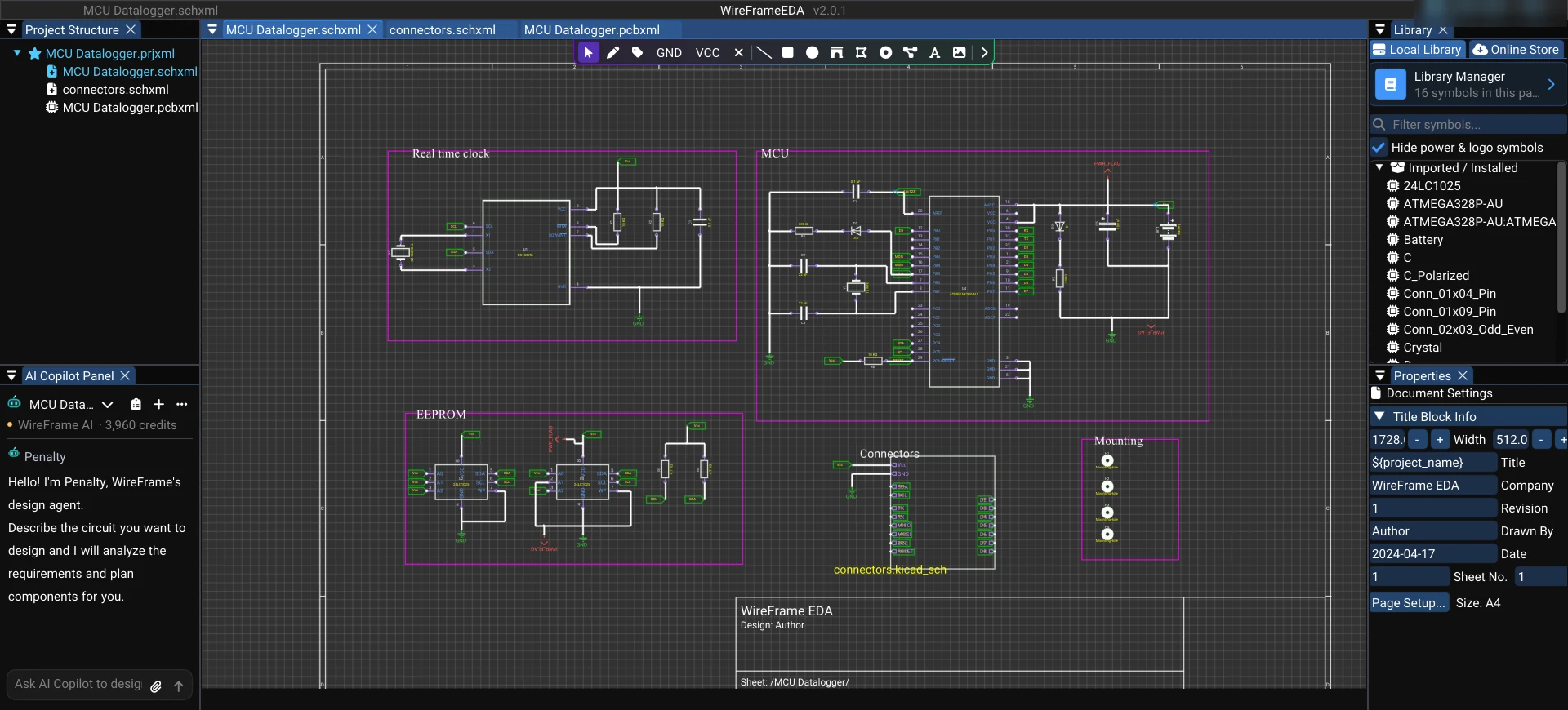
Moving a KiCad project to WireFrame EDA — libraries, schematics and PCB
How to open a KiCad project (.kicad_pro) in WireFrame EDA, reuse your KiCad symbol and footprint libraries, and what to check after the move.
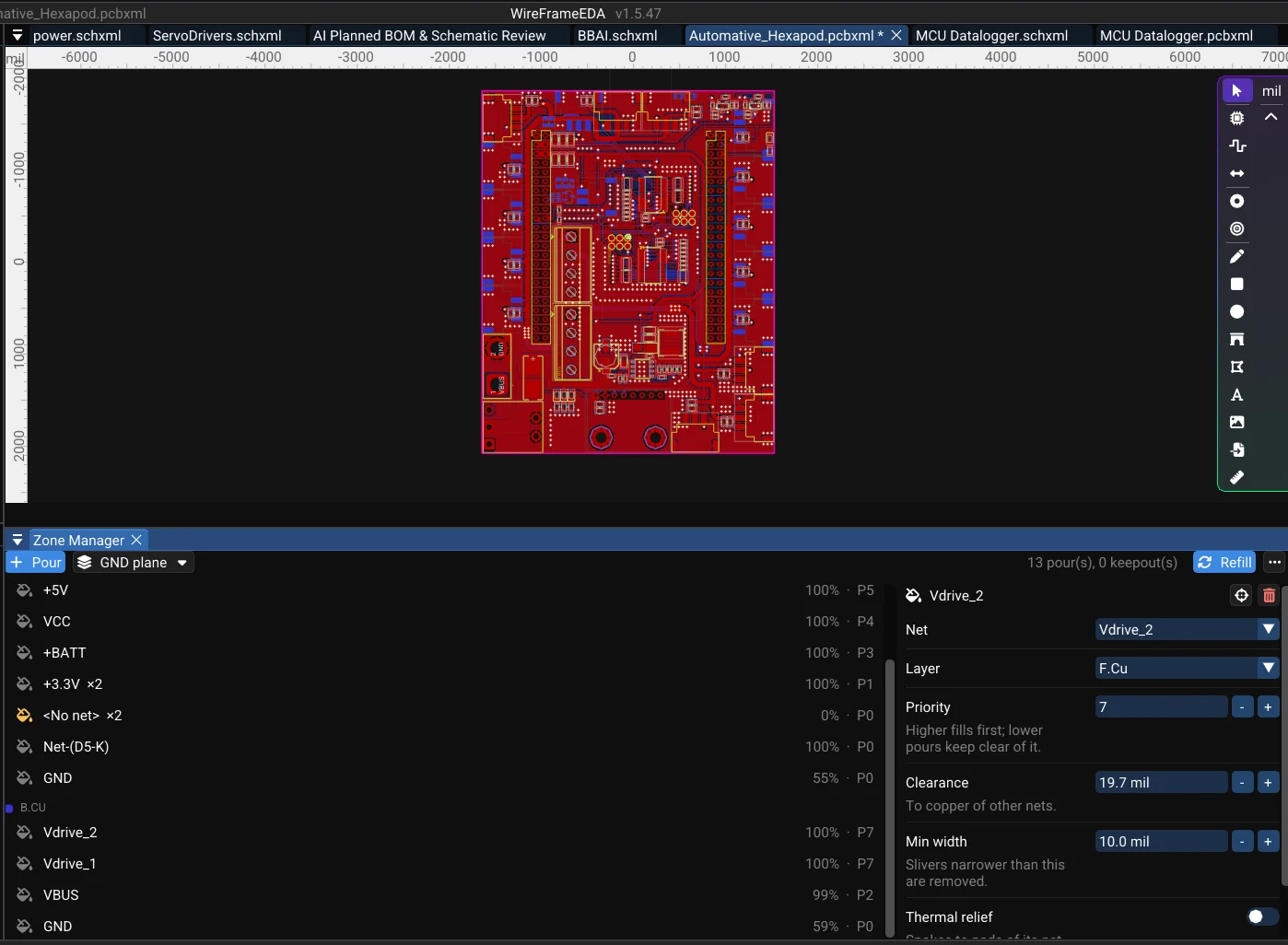
Choosing a 4-layer PCB stackup for microcontroller boards — SIG/GND/PWR/SIG or SIG/GND/GND/SIG?
The two common 4-layer stackups explained, with return paths, ground stitching vias, decoupling and antenna keepouts — and how to set them up in WireFrame EDA.
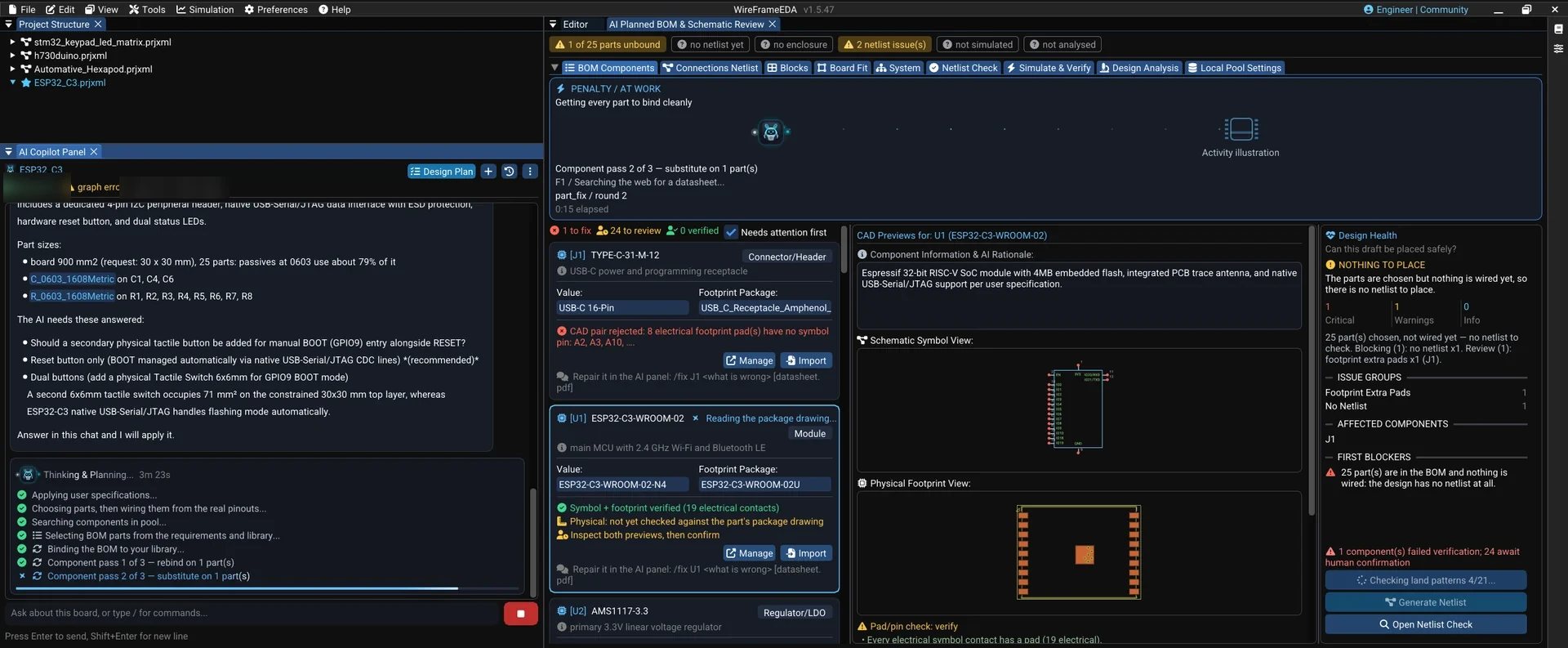
WireFrame's AI Copilot — from a sentence to a datasheet-checked schematic
How the WireFrame EDA AI Copilot turns a written requirement into a BOM, netlist and schematic built from real parts, checks packages and pin maps against datasheets, and repairs rows with /fix.