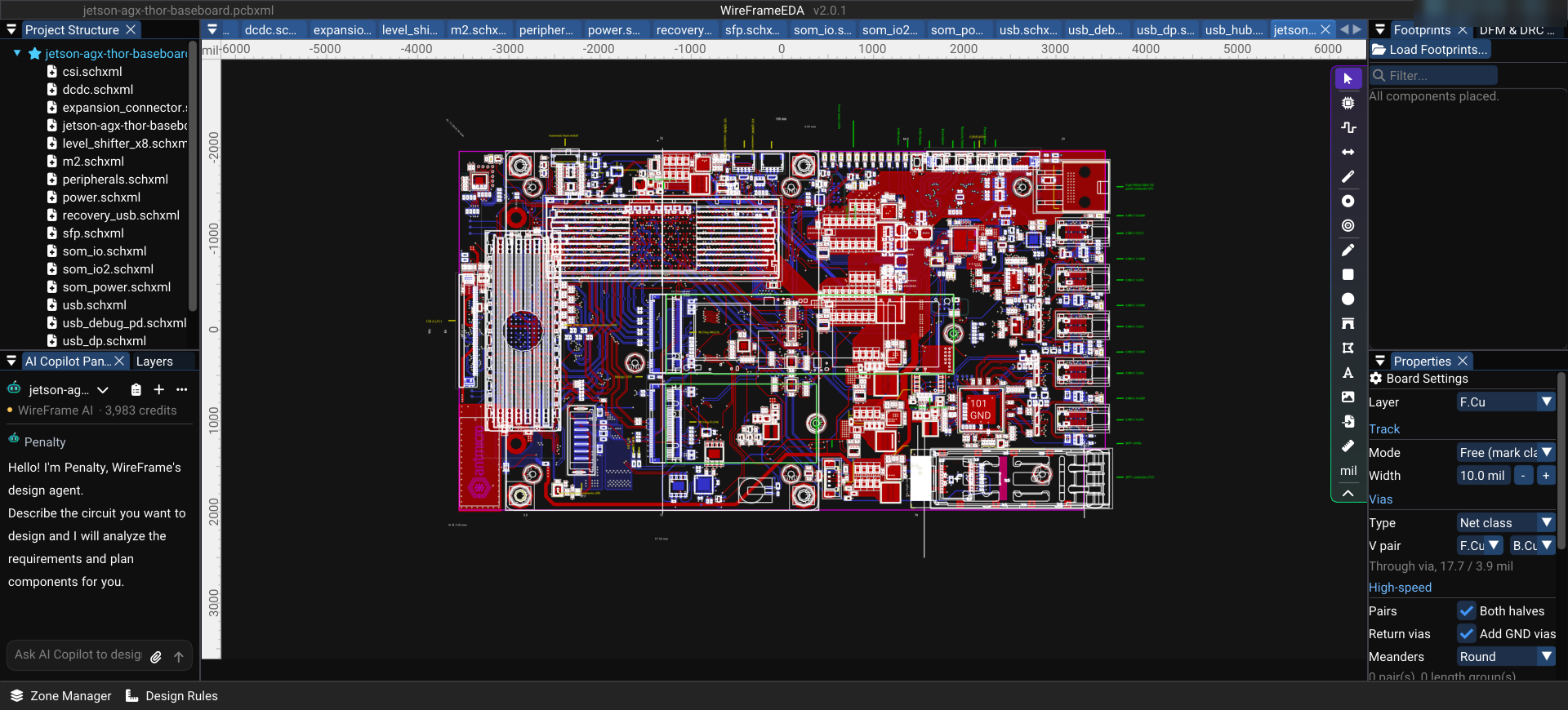
Sample board Jetson AGX Thor baseboard — 10 layers and 1124 parts, opened in WireFrame EDA
Antmicro's open-source carrier for the NVIDIA Jetson AGX Thor module, imported from KiCad into WireFrame EDA — its ten-layer stackup, length-tuned camera pairs and the numbers WireFrame measures on it.
The Jetson AGX Thor baseboard is an open-source carrier board by Antmicro for NVIDIA's Jetson AGX Thor (T5000) module, published as one of KiCad's demo projects. It is the largest board in our sample catalogue: ten copper layers, 1124 footprints and 1375 nets on 180 × 100 mm, with MIPI CSI-2 camera inputs, PCIe, SFP, DisplayPort and USB.
A board like this is where an EDA tool either keeps up or does not. This post imports it into WireFrame EDA and reads it the way you would before changing anything.
The project is KiCad 9 (jetson-agx-thor-baseboard.kicad_pro). In WireFrame choose File › Import › KiCad Project (.kicad_pro, .pro)… and pick it; WireFrame writes its own project next to it (.prjxml, .schxml, .pcbxml) and leaves the KiCad files untouched.
The nine DRC errors are the same nine KiCad's own DRC reports on the original project — the import does not invent violations of its own, which on a board this size is the first thing worth checking.
Each inner layer is easiest to understand from its largest pour:
Layer
Largest pour
What it is for
F.Cu
VCC_IN (local)
parts and short signal fan-out
In1.Cu
GND
reference plane under the top layer
In2.Cu
+3V3
supply pour around signal routing
In3.Cu
GND
reference plane
In4.Cu
+1V8
partial supply pour
In5.Cu
VCC
partial supply pour
In6.Cu
GND
reference plane
In7.Cu
—
signal layer
In8.Cu
GND
reference plane above the bottom layer
B.Cu
+20V (local)
parts and fan-out
Four solid ground planes (In1, In3, In6, In8) give every signal layer a reference next to it — the reason a board with this many fast interfaces is ten layers rather than six.
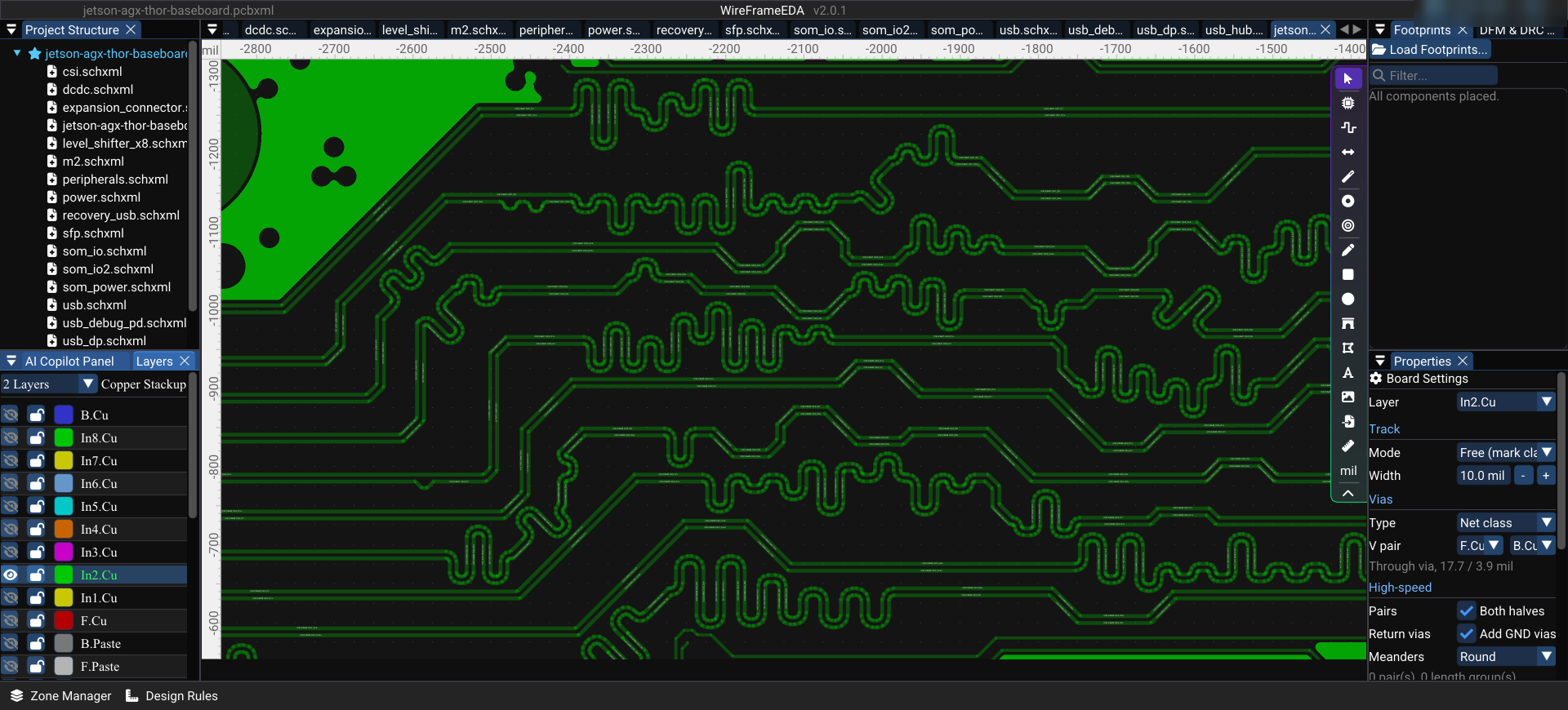
Show a single layer (Layers panel → right-click a layer → Show only this layer) and zoom into the camera connectors: the MIPI CSI-2 lanes run as differential pairs, with serpentine sections where a pair had to be lengthened to match its neighbours.