Update (2026-11): length tuning is in WireFrame 2.0.1 and later: a length and delay readout while you route, and key 7 to add the meanders that are missing — see Length Tuning.
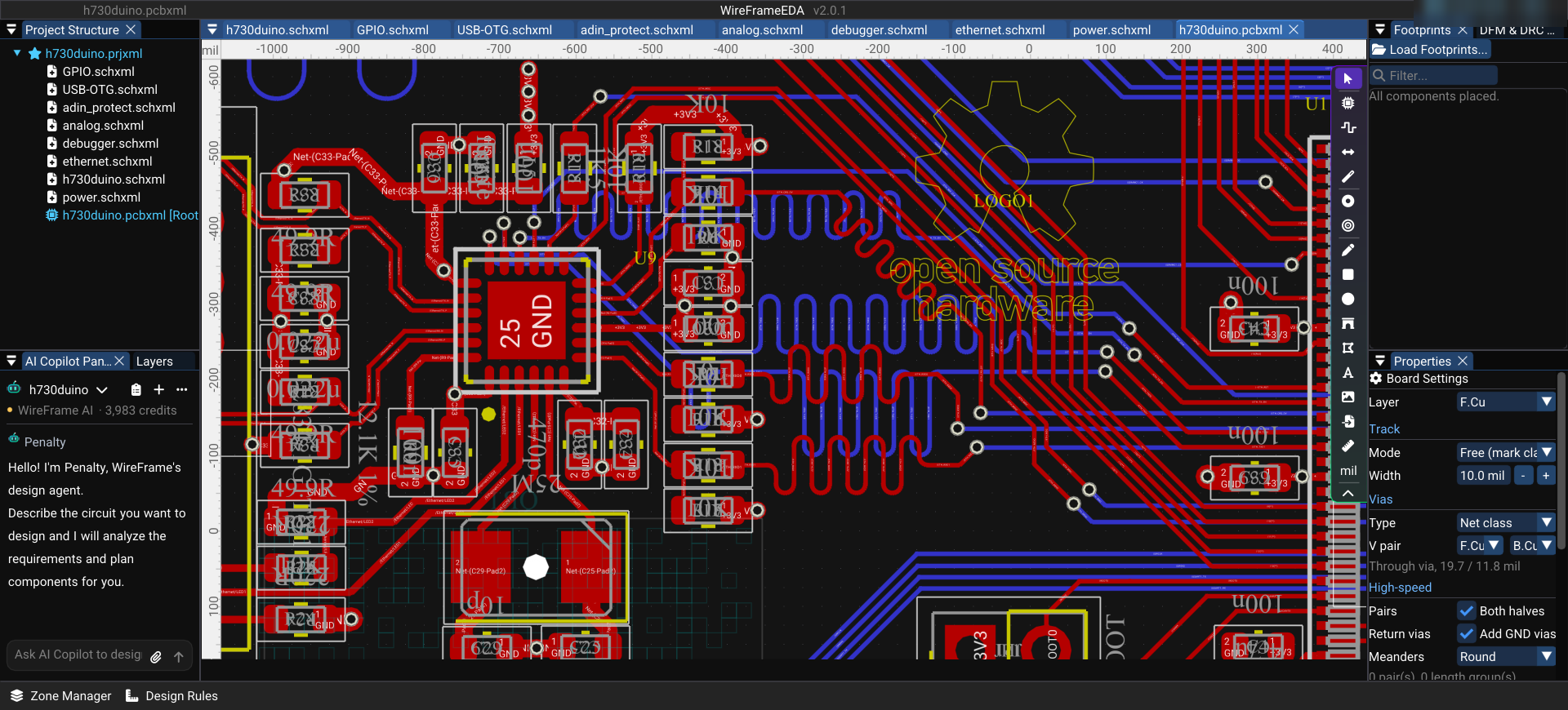
In opening the H730duino in WireFrame we saw a lot of serpentine traces around the Ethernet PHY. This post measures how closely they match.
The numbers#
Summing every track segment of each net on the board imported into WireFrame:
| Group | Nets | Length |
|---|---|---|
| RMII — transmit | ETH_TX_EN, ETH_TXD0, ETH_TXD1 |
56.18 / 56.16 / 56.16 mm |
| RMII — receive | ETH_CRS_DV, ETH_RXD0, ETH_RXD1 |
56.16 mm all three |
| RMII — clock | ETH_REF_CLK |
56.16 mm |
| PHY management | ETH_MDIO, ETH_MDC |
64.64 / 58.42 mm |
| SD card | SDMMC1_CK, SDMMC1_CMD, SDMMC1_D0 |
74.61 / 76.26 / 75.59 mm |
The seven RMII signals — including the 50 MHz clock — are within 0.02 mm of each other. The MDIO/MDC management lines are not matched, and that is perfectly reasonable.
For members
Keep reading — it’s free
Sign in or create a WireFrame account to read the rest of this post and every guide on the blog.
- The rest of this post — about 2 min of reading
- The same account signs in the WireFrame desktop app
- Free design tools, no time limit
Sign in to WireFrame
One account for the desktop app and this site.